How Much Magnesium Per Day for a Man? 420 mg, and the Typical Man Eats 330
Quick Answer: The Recommended Dietary Allowance for magnesium is 400 mg a day for men aged 19 to 30 and 420 mg a day for men 31 and older. Women need 310 to 320 mg. The typical American man eats less: in the national food survey for 2013 to 2016, median intake from food and drink for men 19 and over was 330 mg a day, and 55% fell below the Estimated Average Requirement, the level meant to cover half of healthy people. For men 71 and older, 75% were below it. That gap, roughly 80 to 140 mg a day depending on age, can be closed with food, and if you use a supplement it only needs to be small. The upper limit for magnesium from supplements is 350 mg a day, lower than the RDA, because the RDA counts food and the limit counts only pills and medicines.
“How much magnesium per day” has two honest answers: how much you need, and how much you are probably missing. Most pages give only the first. The second comes from the same government surveys that set the targets, and it changes what a sensible supplement looks like.
How much magnesium you need
These are the Recommended Dietary Allowances set by the Food and Nutrition Board and published by NIH’s Office of Dietary Supplements:
| Age | Men | Women | Pregnancy | Breastfeeding |
|---|---|---|---|---|
| 14 to 18 | 410 mg | 360 mg | 400 mg | 360 mg |
| 19 to 30 | 400 mg | 310 mg | 350 mg | 310 mg |
| 31 to 50 | 420 mg | 320 mg | 360 mg | 320 mg |
| 51 and older | 420 mg | 320 mg |
The Daily Value printed on food and supplement labels is 420 mg for adults, the same as the RDA for men over 30.
How much men actually eat
The US Department of Agriculture publishes usual intake from food and beverages, based on NHANES, the national health and nutrition survey. The magnesium table for 2013 to 2016 shows the gap by age:
| Men, age | Median intake | RDA | Gap to RDA (our subtraction) | Below EAR |
|---|---|---|---|---|
| 19 to 30 | 327 mg | 400 mg | 73 mg | 51% |
| 31 to 50 | 339 mg | 420 mg | 81 mg | 54% |
| 51 to 70 | 339 mg | 420 mg | 81 mg | 54% |
| 71 and older | 277 mg | 420 mg | 143 mg | 75% |
The gap column is our subtraction. The EAR, the Estimated Average Requirement, is the intake expected to meet the needs of half of healthy people in a group; for men over 30 it is 350 mg. Across all men 19 and older, 55% were below it. Women showed the same pattern: median 261 mg against an RDA of 310 to 320 mg, with 51% below the EAR and 63% of women over 70.
Two cautions. These are food and drink only, so supplement users may be doing better. And being below the EAR is not the same as being deficient: NIH notes that symptomatic deficiency from low intake is uncommon in otherwise healthy people because the kidneys cut back on magnesium losses. It does mean that many men, and most older men, are eating less than the amount set as adequate.
Why the supplement limit is lower than the RDA
This is the part that confuses people. The Tolerable Upper Intake Level for magnesium is 350 mg a day for adults, which is less than the 420 mg men are told to get. NIH explains why: the RDA includes magnesium from all sources, while the upper limit applies only to magnesium from supplements and medications. Magnesium from food does not cause problems in healthy people because the kidneys remove the excess, but high doses from pills can cause diarrhea, nausea and cramping.
So a man could, in principle, eat 420 mg from food and take 350 mg from a supplement without breaking either rule. In practice, the numbers above suggest the typical man needs a supplement of well under 350 mg, if any.
Closing the gap with food
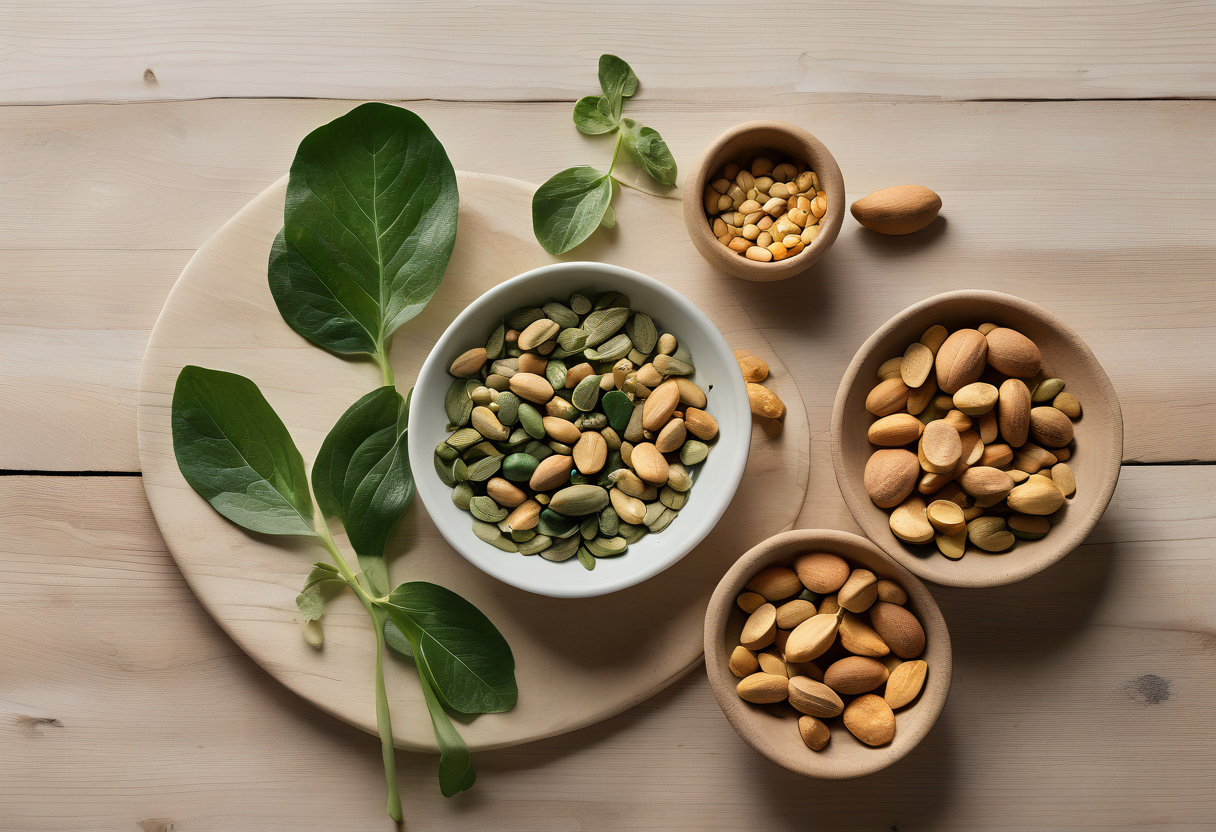
A gap of 80 mg is about half an ounce of pumpkin seeds, or an ounce of almonds. From NIH’s food table:
| Food | Magnesium |
|---|---|
| Pumpkin seeds, roasted, 1 ounce | 156 mg |
| Chia seeds, 1 ounce | 111 mg |
| Almonds, dry roasted, 1 ounce | 80 mg |
| Spinach, boiled, half a cup | 78 mg |
| Cashews, dry roasted, 1 ounce | 74 mg |
| Peanuts, oil roasted, quarter cup | 63 mg |
| Black beans, cooked, half a cup | 60 mg |
| Peanut butter, 2 tablespoons | 49 mg |
| Brown rice, cooked, half a cup | 42 mg |
| Banana, 1 medium | 32 mg |
NIH notes that the body typically absorbs about 30% to 40% of the magnesium in food, which is already built into the RDA. You do not need to adjust for it.
If you use a supplement
- Size it to the gap. For most men that means roughly 100 to 150 mg of elemental magnesium; the 71-and-older group has the largest gap, about 140 mg by our subtraction.
- Read elemental magnesium on the Supplement Facts panel, not the weight of the compound.
- Stay under 350 mg a day from all supplements and medicines, including antacids and laxatives. A single dose of magnesium citrate laxative can hold several times that; see whether magnesium citrate is a laxative.
- Check with a doctor first if you have kidney disease, because NIH notes the risk of magnesium toxicity rises when the kidneys cannot clear the excess.
- Space it from certain drugs: at least 2 hours from oral bisphosphonates, and take tetracycline or quinolone antibiotics 2 hours before or 4 to 6 hours after magnesium. Long-term diuretics and acid-reducing PPIs can lower magnesium, which is worth raising with your doctor.
Which form matters less than the dose. For sleep, the evidence is modest for every form; our pages on magnesium for sleep and glycinate vs citrate cover what the trials found. If you also take calcium, see calcium and magnesium together.
Match the dose to the gap: for most men, food closes it. If you prefer a supplement, USA Medical Magnesium Glycinate is a clean option: magnesium glycinate in a vegetable capsule, nothing else, 175 mg of elemental magnesium per capsule. One capsule covers the typical gap for most men, including those over 70; the two-capsule serving (350 mg) equals the supplemental limit. For a smaller dose, compare low-dose magnesium on Amazon.
Affiliate links: as an Amazon Associate we earn from qualifying purchases, and we may earn a commission from USA Medical through Awin, at no extra cost to you. People with kidney disease should not take magnesium without medical advice.
Frequently Asked Questions
How much magnesium should a man take per day?
The RDA is 400 mg a day for men aged 19 to 30 and 420 mg for men 31 and older, from food, drink and supplements combined. Most men get around 330 mg from food, so if they supplement at all, 100 to 150 mg covers the typical gap. Magnesium from supplements should stay under 350 mg a day unless a doctor advises otherwise.
How much magnesium does a woman need per day?
310 mg a day from age 19 to 30 and 320 mg from 31 onward, with 350 to 360 mg during pregnancy. The median intake for women 19 and older in the 2013 to 2016 survey was 261 mg a day.
Is 500 mg of magnesium a day too much?
From supplements, it is above the 350 mg adult upper limit, and high supplemental doses commonly cause diarrhea, nausea and cramping. From food, 500 mg is not a problem for healthy people, because the kidneys remove the excess. The limit applies to pills, powders and medicines, not to magnesium in food.
Why is the magnesium upper limit lower than the RDA?
Because they measure different things. The RDA counts magnesium from every source, while the upper limit counts only supplements and medications. NIH states that for many age groups the upper limit appears lower than the RDA for exactly this reason.
Do most people get enough magnesium?
Many do not reach the recommended amount. In NHANES 2013 to 2016, 48% of Americans of all ages ate less magnesium from food and drink than their Estimated Average Requirement, with the highest shares among men 71 and older and teenagers. Symptomatic deficiency is still uncommon in healthy people, according to NIH.
Is it safe to take magnesium every day?
For healthy adults, a daily supplement within the 350 mg upper limit is considered safe. People with kidney disease, and those taking bisphosphonates or certain antibiotics, should check with a doctor or pharmacist first.
The Bottom Line
Men need 400 to 420 mg of magnesium a day and typically eat about 330 mg, leaving a gap of roughly 80 mg, or about 140 mg after age 70. Half an ounce of pumpkin seeds or an ounce of almonds covers most of it. If you supplement, match the dose to the gap and keep supplements under 350 mg a day, a limit that sits below the RDA because it counts only what comes from pills.
Sources
- NIH Office of Dietary Supplements. Magnesium Fact Sheet for Health Professionals (updated 6 January 2026): RDAs by age and sex (men 400 mg at 19-30, 420 mg at 31+; women 310/320 mg; pregnancy 350-400 mg); Daily Value 420 mg; food table (pumpkin seeds 156 mg/oz, chia 111, almonds 80, spinach 78 per half cup, cashews 74, peanuts 63, black beans 60, peanut butter 49, brown rice 42, banana 32); 30% to 40% of dietary magnesium absorbed; UL 350 mg for supplemental magnesium and why it can be lower than the RDA; symptomatic deficiency from low intake uncommon in healthy people; toxicity risk with impaired kidney function; interactions with bisphosphonates, tetracyclines and quinolones; diuretics and PPIs. ods.od.nih.gov. Checked 24 September 2026.
- USDA Agricultural Research Service. Usual Nutrient Intake from Food and Beverages, by Gender and Age, What We Eat in America, NHANES 2013-2016 (2019), Table A 36, Magnesium. Men 19+: mean 344 mg, median 330 mg, 55% below EAR; men 19-30 median 327 mg (EAR 330, 51% below); 31-50 median 339 mg (EAR 350, 54%); 51-70 median 339 mg (54%); 71+ median 277 mg (75%); women 19+ median 261 mg, 51% below EAR; women 71+ 63%; all ages 1+ 48% below EAR. ars.usda.gov (PDF). Checked 24 September 2026.
- MedlinePlus (US National Library of Medicine). Magnesium in diet: food sources and the Dietary Reference Intakes, including 420 mg/day for men 31 and older and 310 to 320 mg/day for adult women. medlineplus.gov. Checked 24 September 2026.