Foods High in Nitric Oxide: None Have It, but 7 Vegetables Make It
Quick Answer: No food contains nitric oxide. It is a gas that lasts seconds in the body, so it cannot be stored in a vegetable or a jar. What foods supply is nitrate, which the body converts into nitric oxide in three steps, the first of which happens on your tongue. The richest sources are seven vegetables that carry more than 2,500 mg of nitrate per kilogram: celery, cress, chervil, lettuce, beetroot, spinach and rocket (arugula). Most fruit, meat and water carry very little. In healthy volunteers, 500 mL of beetroot juice lowered blood pressure by up to 10.4/8 mm Hg within about three hours. But in a five-week randomized trial of 243 adults with raised blood pressure, leafy greens supplying 300 mg of nitrate a day did not lower it at all.
Search for “foods high in nitric oxide” and you will find long lists that mix three different things: foods with nitrate, foods with the amino acids the body also uses to make nitric oxide, and foods that simply sound healthy. This page sorts them by the one measured number that matters, nitrate per kilogram, and then sets out what the trials found when people actually ate them. For the wider picture, including exercise and supplements, see our guide on how to increase nitric oxide naturally.
Why food cannot contain nitric oxide
Nitric oxide is a short-lived signalling gas. Your blood vessels make it on demand from the amino acid L-arginine, using enzymes called nitric oxide synthases. That is one route.
The second route, the one food feeds, was mapped by Jon Lundberg’s group at the Karolinska Institute and others. It runs like this:
- You eat nitrate, mostly from vegetables. It is absorbed into the blood.
- Your salivary glands pull nitrate back out of the blood and concentrate it in saliva, to about ten times the level in plasma.
- Bacteria on the back of your tongue convert nitrate to nitrite. You swallow it, and in the stomach and the circulation part of that nitrite becomes nitric oxide.
Step three is why a food list alone does not settle anything. The conversion depends on bacteria that you can wipe out, as the mouthwash section below shows.
The nitrate ranking: which foods actually supply it
A 2024 review in Foods grouped plant foods by measured nitrate content, using European food-safety survey data. These are milligrams of nitrate per kilogram of fresh vegetable.
| Nitrate level | mg per kg fresh weight | Foods |
|---|---|---|
| Very high | Over 2,500 | Celery, cress, chervil, lettuce, beetroot, spinach, rocket (arugula) |
| High | 1,000 to 2,500 | Celeriac, Chinese cabbage, endive, fennel, leek, parsley |
| Medium | 500 to 1,000 | Cabbage, dill, turnip |
| Low | 200 to under 500 | Broccoli, carrot, cauliflower, cucumber, pumpkin, chicory |
| Very low | Under 200 | Artichoke, asparagus, garlic, onion, green bean, mushroom, pepper, potato, sweet potato, tomato, watermelon, apple, banana, grape, pear, orange, strawberry |
| Very low | Under 20 | Meat |
Two things stand out. First, several foods that appear on almost every “nitric oxide foods” list, such as garlic and watermelon, sit in the lowest nitrate group. Whatever else they do, they do not feed the nitrate pathway. Second, the order is not fixed. Nitrate in leafy greens depends heavily on how they were grown: an Iranian survey of 90 vegetable samples found nitrate in leafy vegetables ranging from 1,533 to 15,394 mg per kg of dry matter, a tenfold spread within the same category.
What a serving of the top foods supplies
One meta-analysis of six-week-or-shorter trials covered doses of 322 to 620 mg of nitrate. At more than 2,500 mg per kg, a 100 g bowl of rocket or spinach supplies more than 250 mg, which puts a large salad in the range researchers tested. Beetroot juice is the form most trials used because it delivers a consistent, large dose in one glass.
What happened when people ate them
This is where the evidence splits, and the split is the most useful thing to know.
In healthy people: a clear, fast effect
In the 2008 study that put dietary nitrate on the map, healthy volunteers drank 500 mL of beetroot juice. About three hours later their blood pressure had fallen by as much as 10.4/8 mm Hg, in step with the rise in blood nitrite. When the researchers stopped the volunteers swallowing their saliva, the nitrite rise and the blood-pressure drop disappeared, which confirmed the tongue step.
Meta-analyses pooling many short trials agree on a modest effect. A 2013 analysis of 16 trials in 254 adults found systolic pressure fell by 4.4 mm Hg with nitrate salts or beetroot juice.
In people with high blood pressure: much less, possibly nothing
The people most likely to search for these foods are the ones the evidence supports least.
- The leafy-greens trial. In 2020, Lundberg’s own group randomized 243 adults aged 50 to 70 with systolic pressure of 130 to 159 mm Hg. For five weeks they ate leafy greens supplying 300 mg of nitrate a day, or took 300 mg of nitrate as pills, or took a placebo with low-nitrate vegetables. 24-hour systolic pressure changed by -0.5, -1.2 and -0.6 mm Hg respectively, and the authors concluded that neither the greens nor the pills “decrease ambulatory SBP in subjects with elevated BP.”
- The 2023 meta-analysis. Pooling 19 trials, nitrate lowered systolic pressure by 2.42 mm Hg in healthy people, but in people with hypertension the change was -0.82 mm Hg, not significant (P = 0.35), and 24-hour ambulatory pressure did not move either.
Large population studies still link higher vegetable nitrate intake with less cardiovascular disease. In a Danish cohort of 53,150 adults followed for 23 years, those in the top fifth of intake had systolic pressure 2.58 mm Hg lower and a 14% lower cardiovascular risk than those in the bottom fifth. Observational studies cannot separate nitrate from everything else that comes with eating more vegetables, so the honest reading is: eat these foods, but do not treat a salad as blood-pressure medication.
The mouthwash problem
Because step three of the pathway is bacterial, antiseptic mouthwash can switch it off. In a 2013 study of 19 healthy volunteers, a week of chlorhexidine mouthwash twice a day cut the mouth’s nitrite production by 90% and plasma nitrite by 25%, and systolic and diastolic blood pressure rose by 2 to 3.5 mm Hg. The rise appeared within a day of starting. We cover the details, including fluoride toothpaste, in does mouthwash destroy nitric oxide.
Where nitrate is a concern
Nitrate’s reputation used to be entirely negative, because nitrite can form N-nitroso compounds. A 2024 review in Advances in Nutrition proposed treating nitrate from plant foods as a “conditionally essential nutrient” for cardiovascular health, while saying nitrate from drinking water and cured or processed meats “warrants separate consideration because of the associated health risks.” The meta-analyses it summarised found vegetable-range nitrate intake linked with lower gastric cancer risk, while nitrite and high nitrate levels in drinking water were linked with higher risk of some cancers. The vegetables on this page are not the concern. Cured meats are.
Frequently Asked Questions
What food has the most nitric oxide?
None. Foods supply nitrate, which your body converts to nitric oxide. The richest sources, at over 2,500 mg of nitrate per kg, are celery, cress, chervil, lettuce, beetroot, spinach and rocket.
Does beetroot increase nitric oxide?
Yes. In healthy volunteers, 500 mL of beetroot juice raised blood nitrite and lowered blood pressure by up to 10.4/8 mm Hg within about three hours. The effect disappeared when the volunteers spat out their saliva instead of swallowing it.
Do nitrate-rich foods lower high blood pressure?
Not reliably. In a five-week trial of 243 adults with raised blood pressure, leafy greens supplying 300 mg of nitrate a day changed 24-hour systolic pressure by -0.5 mm Hg, no different from placebo. A 2023 meta-analysis found no significant effect in people with hypertension.
Is watermelon a nitric oxide food?
Not through nitrate. Watermelon is in the lowest nitrate group, under 200 mg per kg, alongside most fruit.
Does mouthwash stop nitric oxide from food?
Antiseptic mouthwash can. A week of chlorhexidine mouthwash cut oral nitrite production by 90% and raised blood pressure by 2 to 3.5 mm Hg in healthy volunteers.
How much nitrate should I eat a day?
There is no recommended intake. One meta-analysis covered trial doses of 322 to 620 mg; a 100 g serving of a vegetable with more than 2,500 mg per kg supplies more than 250 mg.
The Bottom Line
No food contains nitric oxide, but seven vegetables, led by rocket, spinach, beetroot and celery, supply the nitrate your tongue bacteria turn into it. The effect on blood pressure is real and fast in healthy people, and small to absent in people who already have high blood pressure. Eat the greens for what they reliably do, keep antiseptic mouthwash for when you need it, and do not swap them for treatment.
🔎 Our researched pick: CircO2 is a nitric oxide lozenge that dissolves on the tongue, where the nitrate-to-nitrite step described above takes place. Our CircO2 review covers what is in it.
Affiliate link — if you buy through it we may earn a commission at no extra cost to you.
Sources
- Lundberg JO, Weitzberg E, Gladwin MT. The nitrate-nitrite-nitric oxide pathway in physiology and therapeutics. Nat Rev Drug Discov, 2008. PMID 18167491. Checked 1 October 2026.
- Pinaffi-Langley ACDC, Dajani RM, Prater MC, et al. Dietary Nitrate from Plant Foods: A Conditionally Essential Nutrient for Cardiovascular Health. Adv Nutr, 2024;15:100158. PMID 38008359. Saliva nitrate “reaches 10-fold higher than that found in plasma”; nitrate from drinking water and cured/processed meats “warrants separate consideration because of the associated health risks”; summary tables include Bondonno 2021 (53,150 adults, 23 y: SBP -2.58 mm Hg, CVD HR 0.86, highest vs lowest quintile) and cancer meta-analyses (gastric cancer RR 0.80 with dietary nitrate, Song 2015) and nitrate meta-analyses including Ashor 2017 (13 trials, 325 adults, 1 to 6 weeks, 322-620 mg per dose, SBP -4.1 mm Hg). Checked 1 October 2026.
- Olas B. The Cardioprotective Role of Nitrate-Rich Vegetables. Foods, 2024. PMID 38472804. Table: very high >2,500 mg/kg fresh weight (celery, cress, chervil, lettuce, beetroot, spinach, rucola); high 1,000-2,500 (celeriac, Chinese cabbage, endive, fennel, leek, parsley); medium 500-1,000 (cabbage, dill, turnip); low 200-<500 (broccoli, carrot, cauliflower, cucumber, pumpkin, chicory); very low <200 (artichoke, asparagus, garlic, onion, green bean, mushroom, pepper, potato, sweet potato, tomato, watermelon, apple, banana, grape, pear, orange, strawberry); meat <20 mg/kg. Checked 1 October 2026.
- Salehzadeh H, Maleki A, Rezaee R, Shahmoradi B, Ponnet K. The nitrate content of fresh and cooked vegetables and their health-related risks. PLoS One, 2020. PMID 31917821. Sanandaj, Iran; 90 vegetable samples; leafy vegetables 1,533 to 15,394 mg/kg dry matter. Checked 1 October 2026.
- Webb AJ, Patel N, Loukogeorgakis S, et al. Acute blood pressure lowering, vasoprotective, and antiplatelet properties of dietary nitrate via bioconversion to nitrite. Hypertension, 2008;51(3):784-790. PMID 18250365. 500 mL beetroot juice, BP Δmax -10.4/8 mm Hg at about 3 h; effect blocked when enterosalivary conversion was interrupted. Checked 1 October 2026.
- Siervo M, Lara J, Ogbonmwan I, Mathers JC. Inorganic nitrate and beetroot juice supplementation reduces blood pressure in adults: a systematic review and meta-analysis. J Nutr, 2013;143(6):818-826. PMID 23596162. 16 trials, 254 adults, SBP -4.4 mm Hg. Checked 1 October 2026.
- Sundqvist ML, Larsen FJ, Carlström M, et al. A randomized clinical trial of the effects of leafy green vegetables and inorganic nitrate on blood pressure. Am J Clin Nutr, 2020;111(4):749-756. PMID 32091599. 243 adults aged 50-70, SBP 130-159 mm Hg, 5 weeks, 300 mg nitrate/day; 24-h SBP change -0.6 (placebo), -1.2 (nitrate pills), -0.5 (leafy greens) mm Hg, no significant difference. Checked 1 October 2026.
- Zhang Y, Zhang H, An W, Li D, Qin L. Regulatory effect of dietary nitrate on blood pressure: a meta-analysis of randomized controlled trials. Food Funct, 2023;14(4):1839-1850. PMID 36740972. 19 trials; healthy SBP -2.42 mm Hg (P = 0.01); hypertensive SBP -0.82 mm Hg (P = 0.35), 24-h ambulatory SBP -0.22 mm Hg (P = 0.8). Checked 1 October 2026.
- Kapil V, Haydar SM, Pearl V, et al. Physiological role for nitrate-reducing oral bacteria in blood pressure control. Free Radic Biol Med, 2013;55:93-100. PMID 23183324. 19 healthy volunteers, 7 days chlorhexidine mouthwash: oral nitrite production -90%, plasma nitrite -25%, BP +2 to 3.5 mm Hg within 1 day. Checked 1 October 2026.
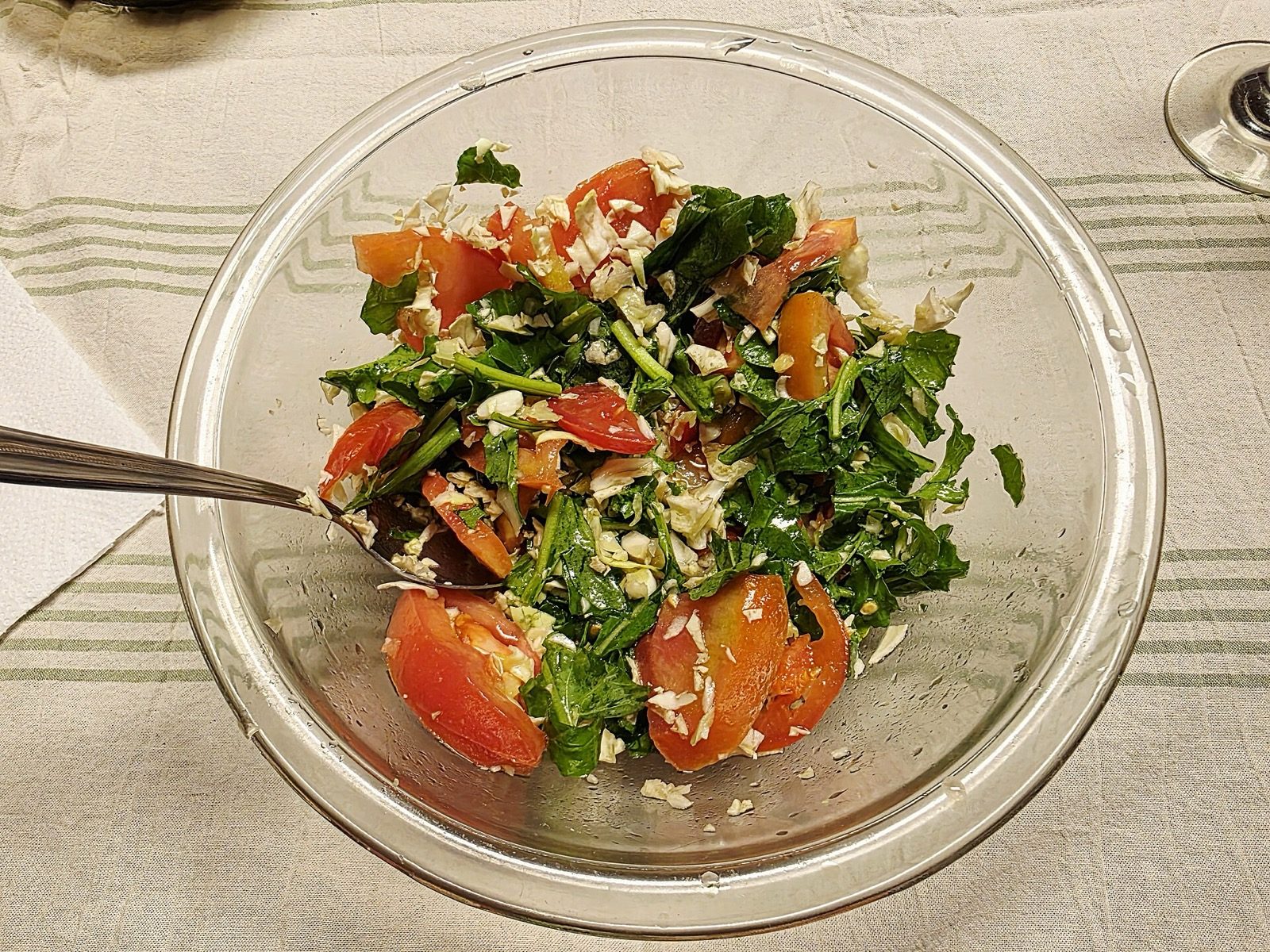
Featured photo: fresh salad with arugula, cabbage and tomato, by Horacio Cambeiro, Wikimedia Commons, CC BY-SA 3.0.