Three-Sided Toothbrush: Better Only When Someone Else Brushes
Quick Answer: A three-sided toothbrush cleans about as well as an ordinary one when you brush your own teeth, and better when someone else is doing the brushing. A 2018 systematic review of 15 publications found that most comparisons of self-brushing showed no difference between triple-headed and single-headed manual brushes, while three of four comparisons in which a caregiver brushed another person’s teeth favored the triple-headed brush. Newer trials point the same way: a 2026 randomized trial in healthy adults found the two designs equal, while 2026 crossover trials in children with special needs and in preschoolers brushed by caregivers found more plaque removed on the hard-to-reach inner surfaces, in less time. The two studies of the Triple Bristle powered model were funded by the company, and in the larger one the extra improvement over a manual brush was not statistically significant. If you brush a child, an older relative or someone with a disability, a three-sided brush is worth trying. If you brush your own teeth well, it is optional.
A three-sided toothbrush has bristles on three faces of the head, so it covers the front, back and biting surface of a tooth in one pass. The design has been tested in clinical trials for more than 25 years, and the results depend on one thing more than any other: who is holding the brush.
When you brush your own teeth
The most useful single source is a 2018 systematic review in the International Journal of Dental Hygiene by Kalf-Scholte and colleagues at the Academic Centre for Dentistry Amsterdam. They found 15 eligible publications with 18 comparisons of triple-headed against single-headed manual toothbrushes, in people without braces. Of the 14 comparisons in which participants brushed their own teeth, the majority showed no difference, with a few favoring the triple-headed brush.
Recent trials agree:
- A 2026 randomized controlled trial in BMC Oral Health gave 48 healthy adults aged 20 to 50 either a triple-headed or a conventional manual brush. Both removed plaque effectively, and there was no significant difference between them in any region of the mouth. The authors suggested the advantage may be specific to people with dexterity problems.
- A 2024 crossover study in the Canadian Journal of Dental Hygiene found the two designs equally effective at removing plaque in 21 adults, with shorter brushing time for the triple-headed brush.
When someone else brushes
This is where the design earns its place. In the 2018 review, three of the four comparisons in which a caregiver brushed another person’s teeth showed significantly better plaque reduction with the triple-headed brush, and the authors concluded it might be favorable when a care-dependent person is brushed by a caregiver.
- A 2026 randomized crossover trial in the European Archives of Paediatric Dentistry had caregivers of 24 preschool children with developmental disabilities brush with each type. The triple-headed brush removed significantly more plaque, especially on the inner surfaces of the teeth, brushing time was shorter, and most caregivers were satisfied with it.
- A 2026 randomized crossover trial in the International Dental Journal in 46 children aged 6 to 12 with special needs, brushing themselves, found lower plaque scores and shorter brushing times with the triple-headed brush (2.3 against 3.3 minutes), and better cleaning of the tongue-side surfaces, regardless of visual-motor skills.
The pattern makes sense. Brushing someone else’s teeth is awkward, the person may not cooperate for long, and the inner surfaces are the hardest to reach. A head that covers three surfaces at once helps most exactly there.
If you brush someone else’s teeth: this is the situation where the evidence for three-sided brushes is strongest. Triple Bristle makes a powered three-sided version; note that the published studies of that specific model were funded by the company, while the independent caregiver trials used manual triple-headed brushes. Triple Bristle three-sided sonic toothbrush
Disclosure: this is an affiliate link and HealthyMag earns a commission if you buy through it, at no extra cost to you. We place it only in the caregiver section, because that is the only group in which trials found a clear advantage.
What about Triple Bristle’s powered brush?
Most of the independent research above tested manual triple-headed brushes. The powered three-sided brush sold as Triple Bristle has two published studies, both from a group at the University of Jordan and both listing Triple Bristle as a funder:
- A 2021 split-mouth study in 52 young adults found both brushes reduced plaque and bleeding, and the Triple Bristle brush did better in the lower jaw and among women.
- A 2023 study in 96 young adults found plaque, bleeding and oral-health quality-of-life scores fell in both groups after a month and were lower in the three-sided group, but the paper reports that between-group difference with p > 0.05, meaning it was not statistically significant.
That is a thin, company-funded evidence base for the specific product, set against a consistent independent finding that the three-sided design helps caregivers.
Braces, and brushing technique
The 2018 review excluded people with fixed orthodontic braces, and studies in that group have compared specialized brushes rather than giving a clear answer. For braces, ask your orthodontist which brush and interdental aids they recommend.
Whatever the brush, how thoroughly and how regularly you brush decides most of the result. If your gums bleed when you brush, see our guide to how to stop bleeding gums.
Frequently Asked Questions
Do three-sided toothbrushes work?
Yes, they remove plaque, but for adults brushing their own teeth they are not better than an ordinary brush: a 2018 systematic review found most self-brushing comparisons showed no difference, and a 2026 randomized trial in healthy adults found the two equal. They do perform better when a caregiver brushes someone else’s teeth.
Who should use a three-sided toothbrush?
Caregivers brushing a child, an older adult or a person with a disability, and people with limited dexterity. In 2026 trials in children with special needs and in preschoolers brushed by caregivers, triple-headed brushes removed more plaque, especially on the inner surfaces, in less time.
Is Triple Bristle better than a regular toothbrush?
The two published studies of the Triple Bristle powered brush were funded by the company. One found an advantage in the lower jaw and among women; in the other, the extra improvement over a manual brush was not statistically significant. The stronger independent evidence is for three-sided brushes used by caregivers.
Is a three-sided toothbrush faster?
Several trials found shorter brushing times with triple-headed brushes, for example 2.3 against 3.3 minutes in a 2026 trial in children with special needs. Shorter brushing is only an advantage if the teeth are as clean afterwards, which in the caregiver studies they were.
Can you use a three-sided toothbrush with braces?
The main systematic review excluded people with braces, so it does not answer that question. Ask your orthodontist which brush and interdental cleaners suit your appliance.
The Bottom Line
For your own teeth, a three-sided toothbrush is about as good as a normal one, so choose whichever you will use properly. If you brush someone else’s teeth, the evidence favors a three-sided brush: it reaches the inner surfaces more easily and cleans more in less time.
Sources
- Kalf-Scholte SM, Van der Weijden GA, Bakker E, Slot DE. Plaque removal with triple-headed vs single-headed manual toothbrushes: a systematic review. International Journal of Dental Hygiene, 2018;16(1):13-23. PMID 28544459. 15 publications, 18 comparisons; of 14 self-brushing comparisons most showed no difference; 3 of 4 caregiver comparisons favored triple-headed. Checked 29 September 2026.
- İşcan Yapar M, Özkal Eminoğlu D, Doğan DB, et al. Evaluation of plaque removal by triple-headed manual toothbrush: a randomized controlled clinical trial. BMC Oral Health, 2026;26(1):678. PMID 41803789. 48 healthy adults aged 20-50; no significant difference between triple-headed and conventional manual brushes. Checked 29 September 2026.
- Vanstraelen N, Tarce M, de Almeida Mello J, et al. Evaluation of plaque removal by a single-headed versus a triple-headed manual toothbrush using different plaque assessment tools. Canadian Journal of Dental Hygiene, 2024;58(2):81-87. PMID 38974826. 21 participants; equally effective; shorter brushing time with triple-headed. Checked 29 September 2026.
- Jitngamkusol J, Kasemkhun P, Korkongwisarut D, et al. Comparison of caregiver-performed toothbrushing with triple- and single-headed toothbrushes in preschool children with developmental disabilities: a randomized crossover study. European Archives of Paediatric Dentistry, published online 17 September 2026. PMID 42753120. 24 caregiver-child pairs; significantly greater plaque reduction and shorter brushing time with triple-headed. Checked 29 September 2026.
- Tanaiadchawoot T, Smutkeeree A, Khamduangdao S, Kasemkhun P. Single vs triple-headed toothbrushes in children with special needs: a randomised crossover trial of brushing efficacy. International Dental Journal, 2026;76(2):109388 (corrigendum 2026;76(3):109569). PMID 41576728. 46 children aged 6-12; lower post-brushing plaque, brushing time 2.3 vs 3.3 minutes. Checked 29 September 2026.
- Al-Omiri MK, Al-Shayyab MH, Alahmari NM, et al. Impacts of the Triple bristles three-sided sonic powered toothbrush on tooth shade, plaque control and gingival health. International Journal of Dental Hygiene, 2021;19(4):382-397. PMID 34529340. 52 young adults, split-mouth; better in lower jaw and among females. Funding listed: Triple Bristle, Dayton, Tennessee. Checked 29 September 2026.
- Al-Omiri MK, Abu-Awwad M, Bustani M, et al. Oral health status, oral health-related quality of life and personality factors among users of three-sided sonic-powered toothbrush versus conventional manual toothbrush. International Journal of Dental Hygiene, 2023;21(2):371-381. PMID 36305227. 96 young adults; scores fell in both groups and more with the three-sided brush, between-group p > 0.05. Funding listed: Triple Bristle, University of Jordan, King Khalid University. Checked 29 September 2026.
- American Dental Association. Toothbrushes, oral health topics: the Seal of Acceptance indicates a toothbrush is safe and effective for plaque removal and reduction of gingivitis. ada.org. Checked 29 September 2026.
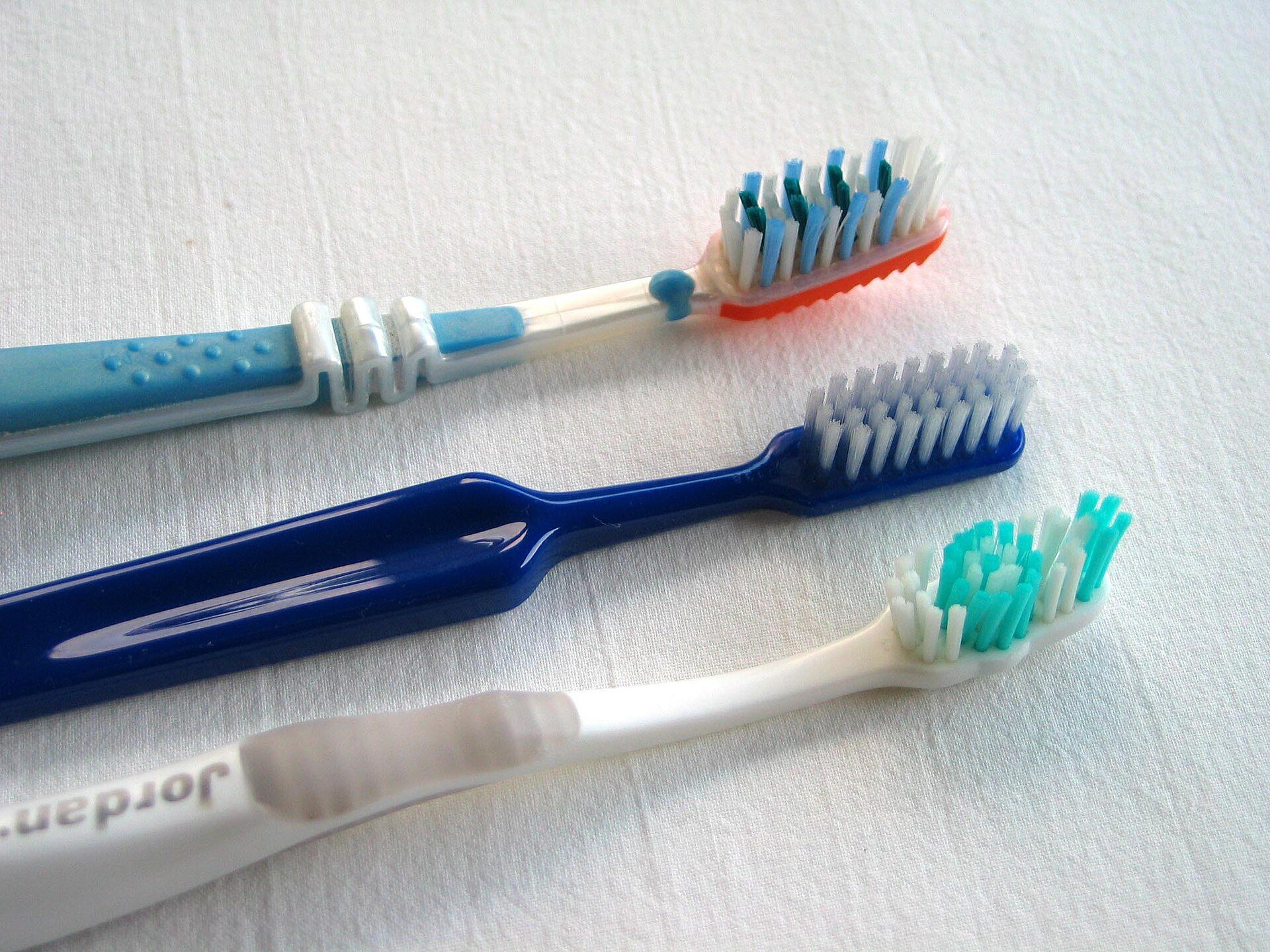
Featured photo: three manual toothbrushes, by Jonas Bergsten, Wikimedia Commons, public domain.