Short-Term Memory Loss Causes: 1 in 4 Clinic Patients May Not Have Dementia
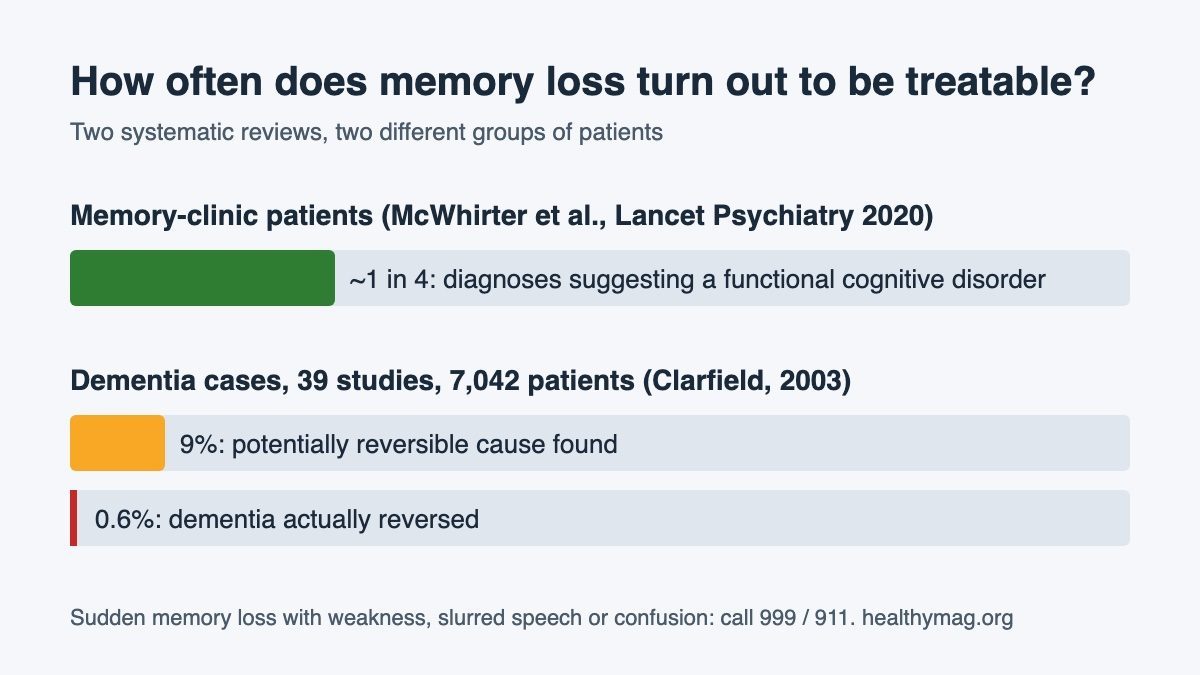
Quick Answer: Short-term memory loss has many causes, and the most common ones are not dementia. The US National Institute on Aging lists depression and anxiety, medication side effects, thyroid, kidney or liver problems, low vitamin B12, sleep problems, alcohol, head injury, and blood clots, tumours or infections in the brain, and says such problems “usually go away once the condition is successfully treated.” The numbers are more sobering than the popular claim that “most memory loss is reversible”: in a meta-analysis of 39 studies and 7,042 patients, 9% of dementia cases had a potentially reversible cause and only 0.6% actually reversed. The reversible share is much larger before dementia: a 2020 Lancet Psychiatry review found that around a quarter of memory-clinic patients received diagnoses suggesting a functional cognitive disorder rather than brain disease. Sudden memory loss with confusion, weakness or slurred speech is a stroke warning sign: call 999 or 911. Our product pick for this topic, Advanced Memory, is in the box near the end of this page.
This page looks at what actually causes short-term memory problems, how often each type of cause turns out to be treatable, and which tests guidelines say a doctor should run. For a broader list of everyday causes, see our earlier guide, Memory Loss Causes: 12 Reasons Your Brain Is Struggling. Every study below was checked against its PubMed record on 9 October 2026.
Is it normal forgetfulness or something else?
The National Institute on Aging (NIA) is clear that some forgetting comes with age. Older adults may not “remember information as well as they once did” or recall it as quickly, and may “occasionally misplace things or forget to pay a bill.” NIA calls these “signs of mild forgetfulness, not a serious memory problem.”
NIA contrasts normal ageing with dementia in a simple table:
- Normal ageing: forgetting which day it is and remembering later. Dementia: losing track of the date or time of year.
- Normal ageing: sometimes forgetting which word to use. Dementia: trouble having a conversation.
- Normal ageing: losing things from time to time. Dementia: misplacing things often and being unable to find them.
- Normal ageing: missing a monthly payment. Dementia: problems taking care of monthly bills.
NIA’s signs that it is time to talk to a doctor include asking the same questions over and over, getting lost in places you used to know well, trouble following recipes or directions, growing confusion about time, people and places, and not taking care of yourself. The NHS adds a simpler test: see a GP if memory problems “are affecting your day-to-day life,” because the cause “could be caused by something that can be treated.”
The causes doctors look for
NIA’s list of factors other than dementia or normal ageing that “may cause memory problems” is the best single checklist:
- Head injury, such as a concussion.
- Blood clots, tumours, or infections in the brain.
- Thyroid, kidney, or liver problems.
- Medication side effects.
- Mental health conditions, such as depression and anxiety.
- Alcohol or drug misuse.
- Sleep problems.
- Low levels of important nutrients, such as vitamin B12.
The NHS names the “common and treatable” ones first: stress, anxiety or depression, and sleeping problems such as insomnia. It also warns: “Do not try to self-diagnose the cause of your memory loss – always see a GP.”
What guidelines say should be tested
The American Academy of Neurology’s evidence-based practice parameter on diagnosing dementia (Knopman and colleagues, Neurology, 2001) states that screening for depression, vitamin B12 deficiency and hypothyroidism “should be performed,” graded as a Guideline. It also says screening for syphilis is not justified unless there is clinical suspicion of neurosyphilis. In practice this means that if you see a doctor about memory problems, a basic workup should include a mood assessment and blood tests for B12 and thyroid function. If yours did not, it is reasonable to ask. Our guide to B12 injections and who actually needs them covers what a low result means.
The finding that cuts against the headlines: how often memory loss really reverses
Many articles, including older ones on this site, say that “many” causes of memory loss are reversible. That is true as a list of possibilities. How often it happens in real patients is a different question, and the best answer comes from Alan Clarfield’s updated meta-analysis in Archives of Internal Medicine (2003).
Clarfield pooled 39 studies covering 7,042 patients, of whom 87.2% had dementia. Alzheimer’s disease was the commonest cause (56.3%), followed by vascular causes (20.3%). Potentially reversible causes were found in 9% of dementia cases, but only 0.6% of dementias actually reversed: 0.29% partially and 0.31% fully. The author’s conclusion: “The reported proportion of dementias that reverse is much lower than previously thought.” He adds that comorbid conditions “should always be treated for its own sake,” in the hope that decline “may at least be delayed.”
Two caveats matter. First, Clarfield could only judge reversal in 23 of the 39 studies. Second, the meta-analysis is from 2003 and is about people who already met criteria for dementia. It does not tell you how often a younger person with poor short-term memory has a treatable cause. For that group, the next study is more relevant.
A quarter of memory-clinic patients may have a functional cognitive disorder
Laura McWhirter, Craig Ritchie and Jon Stone at the University of Edinburgh systematically reviewed the memory-clinic literature for The Lancet Psychiatry (2020). They start from an observation familiar to clinicians: “many who seek help for cognitive symptoms neither have, nor go on to develop, dementia.”
Their finding: “Around a quarter of patients presenting to memory clinics received diagnoses that might indicate the presence of functional cognitive disorders.” In functional cognitive disorders, the memory symptoms are real and distressing but are caused by “functional alterations rather than degenerative brain disease.” The review linked these diagnoses with anxiety and low mood, negative self-evaluation, and symptoms that did not progress over time.
Note the hedging: the diagnoses “might indicate” a functional disorder, because studies used different labels. The authors also warn that these patients “are at risk of iatrogenic harm because of misdiagnosis or inaccurate prediction of future decline.” If you are worried, anxious and noticing lapses but cope with daily life, this is a more likely explanation than early dementia, and it is one that a memory clinic can name and treat.
Medications: the cause hiding in the cupboard
NIA lists medication side effects as a cause of memory problems. The drug class with the most evidence is anticholinergic medicines, which block the neurotransmitter acetylcholine. Two large studies in JAMA Internal Medicine looked at long-term use.
Gray and colleagues (2015) followed 3,434 older adults in the Adult Changes in Thought cohort for a mean of 7.3 years. The most common anticholinergics used were tricyclic antidepressants, first-generation antihistamines and bladder antimuscarinics. Compared with no use, the heaviest cumulative use (more than 1,095 standardised daily doses, roughly three years of daily use) had an adjusted hazard ratio for dementia of 1.54 (95% CI 1.21 to 1.96). Lower levels of use did not reach statistical significance.
Coupland and colleagues (2019) ran a nested case-control study of 284,343 UK patients with a mean age of 82. The highest exposure category had an adjusted odds ratio of 1.49 (95% CI 1.44 to 1.54). Risk was raised for anticholinergic antidepressants, antiparkinson drugs, antipsychotics, bladder antimuscarinics and antiepileptics. The authors estimated that 10.3% of dementia diagnoses were associated with total anticholinergic exposure.
The limitation here is basic: both studies are observational. They show association, not proof that the drugs cause dementia, and the conditions the drugs treat may themselves be linked to dementia. They are also about long-term dementia risk, not the short-term fogginess some people notice when they start a medicine. Do not stop a prescribed medicine on your own. Instead, bring every medicine and supplement you take to your doctor or pharmacist and ask whether any has anticholinergic effects and whether there is an alternative.
Sleep, mood and alcohol
NIA’s tips for dealing with forgetfulness include getting enough sleep, “generally seven to eight hours each night,” avoiding or limiting alcohol, and getting help “if you feel depressed for weeks at a time.” The NHS places stress, anxiety, depression and insomnia among the common, treatable causes. These are also the factors the McWhirter review linked with functional cognitive disorders, which is why a doctor will usually ask about mood and sleep before ordering scans.
NIA’s practical tips can help whatever the cause: follow a daily routine, use to-do lists, calendars and notes, keep your wallet, keys, phone and glasses in the same place each day, stay socially and physically active, and keep blood pressure under control.
If you are looking for a supplement here, Advanced Memory is a memory support supplement (affiliate link; details in our pick below).
Red flags: when memory loss is an emergency
Gradual forgetfulness is a reason to book an appointment. Sudden memory loss is different. The NHS lists “confusion and memory loss” among the symptoms of a stroke, alongside:
- face weakness, with one side of the face drooping;
- arm weakness or numbness in one arm;
- slurred speech or difficulty finding words;
- weakness or numbness down one side of the body;
- blurred vision or loss of sight in one or both eyes;
- dizziness or falling over, a severe headache, or nausea and vomiting.
The NHS says to call 999 (911 in the US) if you think you are having or have had a stroke, or if you have had signs of a stroke “within the last 24 hours even if they’ve now stopped,” and not to drive yourself to hospital. NIA separately lists head injury and blood clots, tumours or infections in the brain as causes of memory problems; memory loss after a blow to the head, or alongside fever and a new severe headache, needs same-day medical assessment.
What to do this week
- Write down examples of what you are forgetting and when it started. The NHS suggests bringing someone who can help describe the problems.
- List every medicine and supplement, including over-the-counter sleep aids and allergy tablets, and ask a pharmacist about anticholinergic effects.
- Ask for the standard tests: mood screening, vitamin B12 and thyroid function, as the AAN guideline recommends.
- Look honestly at sleep, stress and alcohol for the past month.
- Know the stroke signs and call 999 or 911 if memory loss comes on suddenly with any of them.
Frequently Asked Questions
What is the most common cause of short-term memory loss?
In people who already have dementia, Alzheimer’s disease is the commonest cause (56.3% in Clarfield’s meta-analysis). In people who seek help for memory problems but do not have dementia, common causes include stress, anxiety, depression, poor sleep and medication side effects, according to the NHS and NIA. Around a quarter of memory-clinic patients receive diagnoses suggesting a functional cognitive disorder.
Can short-term memory loss be reversed?
It depends on the cause. NIA says problems from conditions such as depression or blood clots “usually go away once the condition is successfully treated.” Once dementia is present, reversal is uncommon: a meta-analysis of 7,042 patients found potentially reversible causes in 9% of dementia cases, and only 0.6% actually reversed.
Can stress or anxiety cause short-term memory loss?
Yes. The NHS lists stress, anxiety and depression among common, treatable causes of memory loss, and a 2020 Lancet Psychiatry review linked functional cognitive disorders with anxiety and low mood.
Which medications cause memory problems?
NIA lists medication side effects as a cause. The best-studied group is anticholinergic drugs, including some antidepressants, first-generation antihistamines, bladder medicines, antipsychotics and antiepileptics, where heavy long-term use was associated with higher dementia risk in large observational studies. Do not stop a medicine without talking to your prescriber.
What blood tests are done for memory loss?
The American Academy of Neurology guideline recommends screening for vitamin B12 deficiency and hypothyroidism, along with screening for depression, when dementia is being assessed.
When is memory loss an emergency?
When it comes on suddenly, especially with confusion, face or arm weakness, slurred speech, vision loss or a severe headache. These are stroke signs; the NHS says to call 999 even if they stop.
The Bottom Line
Most short-term memory lapses are not dementia, and the causes worth checking first are ordinary: mood, stress, sleep, alcohol, medicines, B12 and thyroid. Around a quarter of people who attend memory clinics have a pattern that points to a functional, non-degenerative problem. But the popular line that “most memory loss is reversible” overstates it once dementia is established: in the largest pooled analysis, only 0.6% of dementias reversed. See a doctor for gradual change, ask for the standard tests and a medication review, and treat sudden memory loss with stroke signs as an emergency.
🔎 Our researched pick: Advanced Memory by Advanced Bionutritionals is a memory support supplement sold through the company’s own website. It was not tested in any of the studies on this page, and it does not treat the medical causes described above. Check the ingredient label with your doctor or pharmacist before you start it, especially if you take prescription medicines.
Affiliate link — if you buy through it we may earn a commission at no extra cost to you.
Sources
- Clarfield AM. The decreasing prevalence of reversible dementias: an updated meta-analysis. Arch Intern Med. 2003;163(18):2219-2229. PMID 14557220. 39 studies, 7,042 patients (87.2% with dementia); Alzheimer’s 56.3%, vascular 20.3%; potentially reversible causes in 9%; 0.6% reversed (0.29% partially, 0.31% fully); reversal assessable in 23 of 39 studies; “much lower than previously thought.” Checked 9 October 2026.
- McWhirter L, Ritchie C, Stone J, Carson A. Functional cognitive disorders: a systematic review. Lancet Psychiatry. 2020;7(2):191-207. PMID 31732482. “Around a quarter of patients presenting to memory clinics received diagnoses that might indicate the presence of functional cognitive disorders”; associated with affective symptoms and non-progressive trajectories; risk of iatrogenic harm. Checked 9 October 2026.
- Gray SL, Anderson ML, Dublin S, et al. Cumulative use of strong anticholinergics and incident dementia: a prospective cohort study. JAMA Intern Med. 2015;175(3):401-407. PMID 25621434. Mean follow-up 7.3 years; HR 1.54 (95% CI 1.21-1.96) for more than 1,095 standardised daily doses vs non-use. Checked 9 October 2026.
- Coupland CAC, Hill T, Dening T, et al. Anticholinergic drug exposure and the risk of dementia: a nested case-control study. JAMA Intern Med. 2019;179(8):1084-1093. PMID 31233095. 284,343 patients, mean age 82.2; adjusted OR 1.49 (95% CI 1.44-1.54) for more than 1,095 TSDDs; population-attributable fraction 10.3%. Checked 9 October 2026.
- Knopman DS, DeKosky ST, Cummings JL, et al. Practice parameter: diagnosis of dementia (an evidence-based review). Report of the Quality Standards Subcommittee of the American Academy of Neurology. Neurology. 2001;56(9):1143-1153. PMID 11342678. Screening for depression, B12 deficiency and hypothyroidism “should be performed” (Guideline). Checked 9 October 2026.
- National Institute on Aging. Memory Problems, Forgetfulness, and Aging. nia.nih.gov. Normal ageing vs dementia table; signs to talk with a doctor; list of other causes; problems “usually go away once the condition is successfully treated”; seven to eight hours of sleep. Checked 9 October 2026.
- NHS. Memory loss (amnesia). nhs.uk. Stress, anxiety, depression and insomnia as common treatable causes; “Do not try to self-diagnose.” Checked 9 October 2026.
- NHS. Symptoms of a stroke. nhs.uk. “Confusion and memory loss” among stroke symptoms; call 999 for signs within the last 24 hours even if they have now stopped. Checked 9 October 2026.