How Much K2 Per Day? The Doses Trials Used, 180 mcg to 45 mg
Quick Answer: There is no official daily amount for vitamin K2. The US Adequate Intake of 120 mcg a day for men and 90 mcg for women covers all vitamin K combined, mostly the K1 in leafy greens, and no upper limit has been set. The trials that tested K2 used two very different doses: 180 mcg a day of MK-7 in the three-year Dutch trial that slowed bone loss in postmenopausal women, and 45 mg a day of MK-4, the dose of an osteoporosis drug used in Japan, which is 250 times more by weight. Doubling MK-7 to 360 or 375 mcg did not change bone density in two other trials. In our check of 500 K2 products on the market, the median label dose was 100 mcg and 76% contained less than 180 mcg. If you take a warfarin-type blood thinner, the relevant number is far smaller: as little as 10 mcg of MK-7 a day lowered clotting-test results enough to matter in at least 40% of people in a controlled study.
“How much K2 should I take” has an unusual answer: the question assumes a number exists that does not. What exists instead are the doses researchers happened to test, and they differ by a factor of 250 depending on which form of K2 is in the bottle. This page sets those doses side by side. For what K2 does in the body and the population studies behind the interest in it, see our guide to vitamin K2 for heart and bones.
There is no K2 recommendation, only a vitamin K one
The Food and Nutrition Board did not have enough evidence to set an Estimated Average Requirement for vitamin K, so it set Adequate Intakes based on what healthy populations eat. Those intakes cover every form of vitamin K together.
| Group | Vitamin K Adequate Intake per day |
|---|---|
| Men 19 and older | 120 mcg |
| Women 19 and older | 90 mcg |
| Pregnancy and breastfeeding (19+) | 90 mcg |
| Teens 14 to 18 | 75 mcg |
The Daily Value printed on supplement labels is 120 mcg. No Tolerable Upper Intake Level exists, because the Board found vitamin K to have a low potential for toxicity. Most of the vitamin K people eat is K1, from vegetables such as collards, spinach and kale. K2 comes mainly from fermented foods and some animal foods, and one food dominates: a 3-ounce serving of natto provides about 850 mcg, as MK-7.
The number most often quoted as a K2 “dose” from diet comes from the Rotterdam Study, an observational cohort. People in its highest third of menaquinone intake ate more than 32.7 mcg a day, and had 57% lower risk of dying from coronary heart disease than those eating less than 21.6 mcg. That is a food intake associated with an outcome, not a tested dose, and it is lower than almost every supplement on sale.
The doses that were actually tested
K2 supplements come in two main forms, and they were tested in two separate dose ranges. MK-7, the form in natto, has a longer half-life than vitamin K1 and was tested in micrograms. MK-4, also called menatetrenone, is an approved osteoporosis drug in Japan and was tested in milligrams.
| Trial | Who | Form and daily dose | Length | Result |
|---|---|---|---|---|
| Knapen 2013 | 244 healthy postmenopausal women | MK-7, 180 mcg | 3 years | Slower decline in bone mineral density at the lumbar spine and femoral neck, not the total hip |
| Knapen 2015 (same women) | 244 healthy postmenopausal women | MK-7, 180 mcg | 3 years | Lower arterial stiffness (pulse wave velocity) |
| Emaus 2010 | 334 women, 1 to 5 years after menopause | MK-7, 360 mcg | 1 year | No difference in bone loss at any site |
| Rønn 2016 | 148 postmenopausal women with osteopenia | MK-7, 375 mcg | 1 year | Tibia microarchitecture preserved; no difference in bone density at any site |
| Zwakenberg 2019 | 68 people with type 2 diabetes and cardiovascular disease | MK-7, 360 mcg | 6 months | No effect on calcification by CT; active calcification tended to increase |
| Knapen 2007 | 325 postmenopausal women | MK-4, 45 mg | 3 years | Hip bone strength maintained; no effect on bone mineral density |
| Binkley 2009 | 381 postmenopausal women (three groups) | MK-4, 45 mg | 1 year | No change in bone turnover, density or geometry |
Two things stand out. First, the one long trial with a clearly positive bone result used 180 mcg, and the trials that used twice as much did not find a bone density benefit. That does not prove 180 mcg is better than 360 mcg: the trials differed in length, population and design. It does mean there is no trial evidence that more MK-7 than 180 mcg adds anything.
Second, the Dutch authors were careful about who their result applies to: “Whether these results can be extrapolated to other populations, e.g., children and men, needs further investigation.” Every MK-7 bone trial in the table enrolled women after menopause.
What the fracture evidence says
Bone density is a stand-in. What matters is fractures, and there the story has changed. A 2006 meta-analysis in Archives of Internal Medicine pooled seven Japanese MK-4 trials and reported large reductions in hip and vertebral fractures. In 2018 its own senior author published a caution in JAMA Internal Medicine that the review had included problematic trials.
The updated 2019 review by the same York group, covering 36 studies, concluded: “For post-menopausal or osteoporotic patients, there is no evidence that vitamin K affects bone mineral density or vertebral fractures; it may reduce clinical fractures; however, the evidence is insufficient to confirm this.” The odds ratio for any clinical fracture was 0.72, but restricted to trials at low risk of bias it was 0.76 with a confidence interval crossing 1.
The largest single MK-4 trial, the Japanese OF study of 4,378 osteoporotic women given calcium with or without menatetrenone as 15 mg capsules, found no significant difference in new vertebral fractures over 36 months in either of its subgroups, and adverse events were more frequent with menatetrenone.
What is in K2 supplements
We pulled every on-market product in the NIH Dietary Supplement Label Database with K2, MK-7, MK-4 or menaquinone in its name: 509 records. Six listed no K2 amount, and three were clear unit-entry errors (products named “100 mcg” and “300 mcg” recorded in milligrams), leaving 500 products. For each, we took the most K2 the label says to take in a day. Many are combined vitamin D3 and K2 products.
| K2 per day on the label | Products | Share |
|---|---|---|
| Under 45 mcg | 23 | 4.6% |
| 45 mcg | 39 | 7.8% |
| 46 to 99 mcg | 142 | 28.4% |
| 100 to 179 mcg | 175 | 35.0% |
| 180 mcg (the Knapen trial dose) | 37 | 7.4% |
| 181 to 359 mcg | 40 | 8.0% |
| 360 to 999 mcg | 27 | 5.4% |
| 1 mg to under 45 mg | 13 | 2.6% |
| 45 mg (the MK-4 trial dose) | 4 | 0.8% |
The median was 100 mcg, and the most common doses were 100 mcg (131 products) and 90 mcg (74). 379 products, 76%, contain less than the 180 mcg used in the three-year trial. Only 4 products reach the 45 mg MK-4 dose. Where the form was stated, 382 products were MK-7 only and 55 contained MK-4.
So most K2 on sale sits in a range that no bone trial tested: above what the Rotterdam diet data describe, below the one positive MK-7 trial, and nowhere near the MK-4 doses.
The dose that matters most: if you take a blood thinner
Vitamin K reverses the effect of warfarin (Coumadin) and similar drugs, which work by blocking vitamin K. The NIH Office of Dietary Supplements advises people on these drugs to keep their vitamin K intake consistent. For K2, a Maastricht study measured how little it takes.
Theuwissen and colleagues anticoagulated 18 healthy volunteers with acenocoumarol, a warfarin-type drug, then added MK-7 at rising doses. At 10 mcg a day, two hematologists judged the drop in INR clinically relevant in at least 40% of subjects; at 20 mcg, in at least 60%. At 45 mcg, the group’s average INR fell by about 40%. The authors concluded that “the use of MK-7 supplements needs to be avoided in patients receiving VKA therapy.”
Set that against the label data: 98.6% of the 500 products contain 10 mcg a day or more. For someone on warfarin, there is no small K2 dose to choose. Do not start, stop or change any vitamin K supplement without the clinician who manages your anticoagulation.
So how much, in practice?
- From food: the Adequate Intake is 120 mcg of total vitamin K for men and 90 mcg for women. There is no separate K2 target.
- If you choose an MK-7 supplement for bone health after menopause: 180 mcg a day is the dose with a three-year trial behind it. The trials at 360 to 375 mcg did not improve bone density further, and the reviews say fracture benefit is unproven.
- MK-4 at 45 mg: this is the dose of an osteoporosis drug used in Japan. Its fracture evidence has weakened since the trials were re-examined, and it is not a dose to self-prescribe.
- On warfarin or another vitamin K antagonist: the answer is no K2 supplement unless your anticoagulation clinic says otherwise.
We do not link to any product on this page. The trial evidence does not establish that K2 prevents fractures, and the one clearly positive dose is a narrow result in one group of women.
Frequently Asked Questions
How much vitamin K2 should I take per day?
There is no official K2 recommendation. The Adequate Intake for all vitamin K is 120 mcg for men and 90 mcg for women. The MK-7 dose with the longest positive trial is 180 mcg a day, tested in postmenopausal women.
Is 100 mcg of K2 enough?
It is the most common dose on the market, but no bone trial tested it. It is more than the roughly 33 mcg linked to lower heart disease death in the Rotterdam diet study, and less than the 180 mcg used in the three-year Dutch trial.
Is 200 or 360 mcg of K2 too much?
No upper limit has been set for vitamin K, and the 360 mcg trial in people with diabetes reported no adverse events. The trials at 360 and 375 mcg also found no benefit to bone density. For anyone on warfarin, any of these doses is too much without medical supervision.
What is the difference between MK-4 and MK-7 doses?
MK-7 was tested in micrograms, 180 to 375 mcg a day in the trials above. MK-4 was tested at 45 mg a day, 250 times more by weight. The two are different compounds tested at different doses, so one dose cannot be converted into the other.
Can I take K2 with warfarin?
Not without your prescriber. In a controlled study, 10 mcg of MK-7 a day lowered INR enough to matter in at least 40% of people on a warfarin-type drug, and 98.6% of the products we checked contain at least that much.
Should K2 be taken with vitamin D?
Many products combine them, and the Rønn trial gave all participants calcium and vitamin D. There is no trial showing that a particular K2 dose is needed alongside a particular vitamin D dose.
The Bottom Line
No one has set a daily amount for vitamin K2. The trial doses are 180 mcg of MK-7 or 45 mg of MK-4, the higher MK-7 doses added nothing to bone density, and the fracture evidence is now judged insufficient. Three quarters of the products on sale contain less than the trial dose, and nearly all contain enough to interfere with warfarin.
Sources
- NIH Office of Dietary Supplements. Vitamin K: Fact Sheet for Health Professionals (updated 29 March 2021): Adequate Intakes (men 19+ 120 mcg, women 19+ 90 mcg, pregnancy and lactation 90 mcg, 14-18 years 75 mcg); DV 120 mcg; no UL “because of its low potential for toxicity”; natto 3 oz 850 mcg as MK-7; warfarin interaction and advice to maintain consistent intake; MK-4 trials at 15 or 45 mg/day. ods.od.nih.gov. Checked 30 September 2026.
- NIH Office of Dietary Supplements. Dietary Supplement Label Database (DSLD), API v9, queried 30 September 2026: 509 on-market records with K2, MK-7, MK-4 or menaquinone in the product name; 6 without a K2 amount; 3 excluded as unit-entry errors (products named “100 mcg” and “300 mcg” recorded in mg); 500 analyzed at the label’s maximum daily dose. Under 45 mcg 23; 45 mcg 39; 46-99 mcg 142; 100-179 mcg 175; 180 mcg 37; 181-359 mcg 40; 360-999 mcg 27; 1 mg to under 45 mg 13; 45 mg 4. Median 100 mcg; below 180 mcg 379 (76%); 10 mcg or more 493 (98.6%). Forms: MK-7 only 382, containing MK-4 55, unspecified 63. Our analysis. dsld.od.nih.gov.
- Geleijnse JM, Vermeer C, Grobbee DE, et al. Dietary intake of menaquinone is associated with a reduced risk of coronary heart disease: the Rotterdam Study. J Nutr, 2004;134(11):3100-3105. PMID 15514282. Upper tertile more than 32.7 mcg/day (about 33 mcg), 57% lower coronary heart disease mortality versus under 21.6 mcg/day (as reported by ODS). Checked 30 September 2026.
- Knapen MH, Drummen NE, Smit E, Vermeer C, Theuwissen E. Three-year low-dose menaquinone-7 supplementation helps decrease bone loss in healthy postmenopausal women. Osteoporos Int, 2013;24(9):2499-2507. PMID 23525894. n=244, 180 mcg MK-7/day, 3 years. Checked 30 September 2026.
- Knapen MH, Braam LA, Drummen NE, et al. Menaquinone-7 supplementation improves arterial stiffness in healthy postmenopausal women. Thromb Haemost, 2015;113(5):1135-1144. PMID 25694037. Checked 30 September 2026.
- Emaus N, Gjesdal CG, Almås B, et al. Vitamin K2 supplementation does not influence bone loss in early menopausal women: a randomised double-blind placebo-controlled trial. Osteoporos Int, 2010;21(10):1731-1740. PMID 19937427. n=334, 360 mcg MK-7/day, 12 months. Checked 30 September 2026.
- Rønn SH, Harsløf T, Pedersen SB, Langdahl BL. Vitamin K2 (menaquinone-7) prevents age-related deterioration of trabecular bone microarchitecture at the tibia in postmenopausal women. Eur J Endocrinol, 2016;175(6):541-549. PMID 27625301. n=148, 375 mcg MK-7/day, 12 months; no BMD difference at any site. Checked 30 September 2026.
- Zwakenberg SR, de Jong PA, Bartstra JW, et al. The effect of menaquinone-7 supplementation on vascular calcification in patients with diabetes: a randomized, double-blind, placebo-controlled trial. Am J Clin Nutr, 2019;110(4):883-890. PMID 31387121. n=68, 360 mcg MK-7/day, 6 months. Checked 30 September 2026.
- Knapen MH, Schurgers LJ, Vermeer C. Vitamin K2 supplementation improves hip bone geometry and bone strength indices in postmenopausal women. Osteoporos Int, 2007;18(7):963-972. PMID 17287908. n=325, 45 mg MK-4/day, 3 years. Checked 30 September 2026.
- Binkley N, Harke J, Krueger D, et al. Vitamin K treatment reduces undercarboxylated osteocalcin but does not alter bone turnover, density, or geometry in healthy postmenopausal North American women. J Bone Miner Res, 2009;24(6):983-991. PMID 19113922. n=381, 1 mg phylloquinone, 45 mg MK-4 or placebo, 12 months. Checked 30 September 2026.
- Cockayne S, Adamson J, Lanham-New S, et al. Vitamin K and the prevention of fractures: systematic review and meta-analysis of randomized controlled trials. Arch Intern Med, 2006;166(12):1256-1261. PMID 16801507. Checked 30 September 2026.
- Torgerson DJ. Caution to readers about systematic review on vitamin K and prevention of fractures that included problematic trials. JAMA Intern Med, 2018;178(6):863-864. PMID 29582044. Checked 30 September 2026.
- Mott A, Bradley T, Wright K, et al. Effect of vitamin K on bone mineral density and fractures in adults: an updated systematic review and meta-analysis of randomised controlled trials. Osteoporos Int, 2019;30(8):1543-1559. PMID 31076817. 36 studies; clinical fracture OR 0.72 (0.55-0.95), low risk of bias 0.76 (0.58-1.01); vertebral fracture OR 0.96. Checked 30 September 2026.
- Inoue T, Fujita T, Kishimoto H, et al. Randomized controlled study on the prevention of osteoporotic fractures (OF study): a phase IV clinical study of 15-mg menatetrenone capsules. J Bone Miner Metab, 2009;27(1):66-75. PMID 19082528. n=4,378; no significant difference in new vertebral fractures at 36 months. Checked 30 September 2026.
- Theuwissen E, Teunissen KJ, Spronk HM, et al. Effect of low-dose supplements of menaquinone-7 (vitamin K2) on the stability of oral anticoagulant treatment: dose-response relationship in healthy volunteers. J Thromb Haemost, 2013;11(6):1085-1092. PMID 23530987. 18 volunteers on acenocoumarol; 10, 20 and 45 mcg MK-7/day. Checked 30 September 2026.
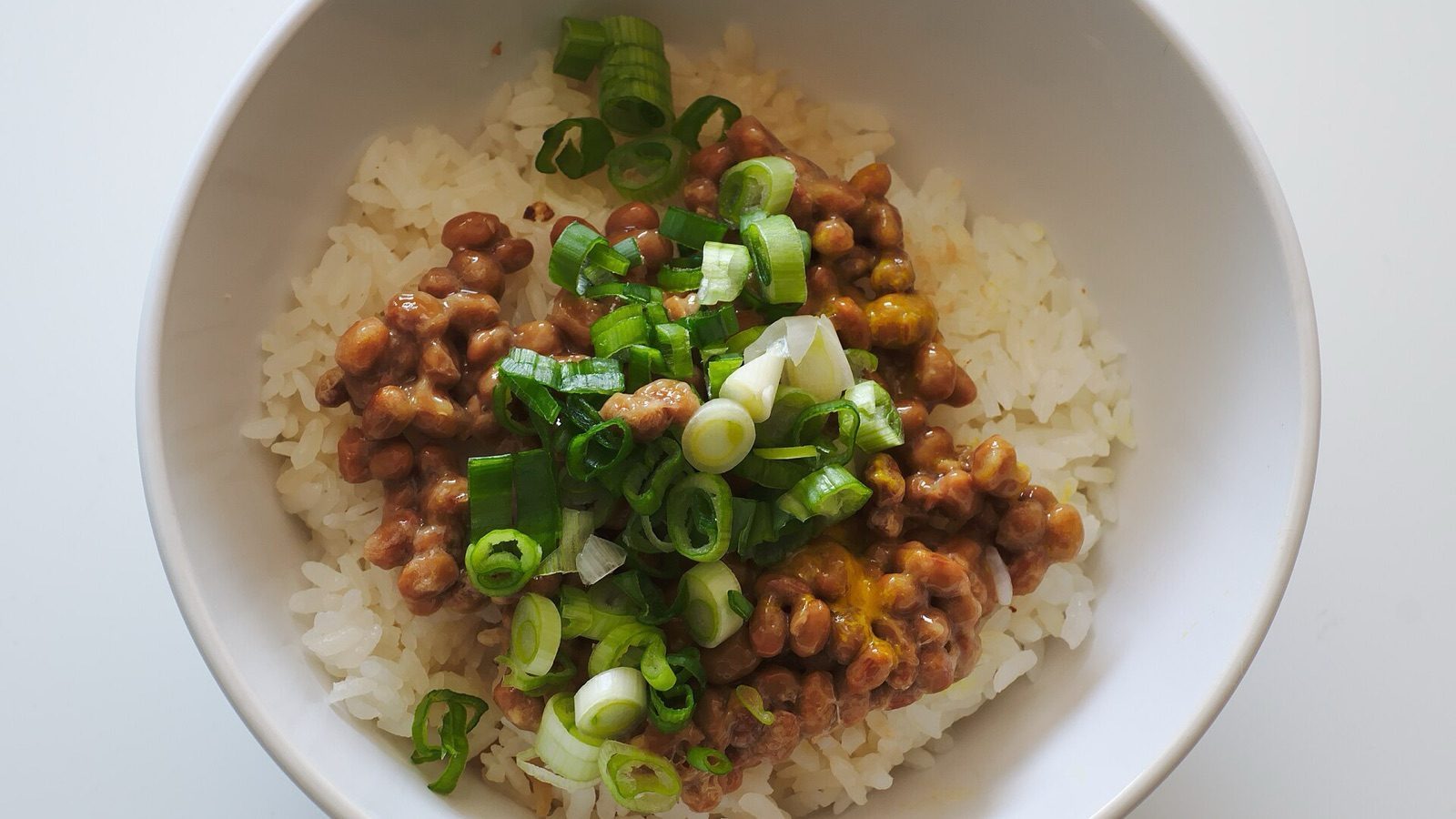
Featured photo: natto and green onion on rice, by Dllu, Wikimedia Commons, CC BY-SA 4.0.