Red Light Therapy for Hair Growth: Tested in 5 Kinds of Hair Loss, Shown in 1
Quick Answer: Red light therapy can increase hair counts, but the evidence covers one kind of hair loss: pattern hair loss (androgenetic alopecia). A 2025 meta-analysis found 38 studies with 3,098 patients, and 2,930 of them had pattern hair loss; for scarring alopecia, alopecia areata, telogen effluvium and chemotherapy hair loss, the data were too thin to pool. In sham-controlled trials of laser combs, helmets and LED caps used at home for 16 to 26 weeks, treated scalps gained roughly 12 to 41 more hairs per cm² than sham. One head-to-head trial in 75 men found results comparable to 5% minoxidil. The catch: in two laser-comb trials reviewed by Cochrane, the women using the real device did not rate it more effective than the women using the fake one. There is no advertisement on this page; see why below.
Most pages ranking for “red light therapy for hair growth” are written by companies that sell red light devices. This page goes back to the trials: what kind of hair loss they enrolled, what device they used, how often, and what the participants themselves said. For red light therapy’s other uses, see our red light therapy benefits page, where hair loss ranks second of seven.
Which hair loss: 5 kinds tested, 1 with pooled results
A 2025 systematic review from the University of Miami set out to cover every type of alopecia. It found 38 studies describing 3,098 patients:
| Type of hair loss | Patients in studies | Pooled result? |
|---|---|---|
| Androgenetic alopecia (male or female pattern hair loss) | 2,930 | Yes: more hair density than placebo, at under 20 weeks and over 20 weeks |
| Alopecia areata (patchy, autoimmune) | 50 | No, “statistical information was insufficient” |
| Scarring alopecia | 49 | No |
| Chemotherapy-induced alopecia | 32 | No |
| Telogen effluvium (shedding after illness, stress or childbirth) | 17 | No |
The authors’ own conclusion: red light therapy “is a promising treatment option for patients with androgenetic alopecia, but future studies are needed to better understand its efficacy in other alopecia types.”
The FDA’s device category says the same thing in regulatory language. Home hair-growth lasers and LED caps are cleared under product code OAP, “Laser, Comb, Hair”, whose definition is to “promote hair growth in males with androgenic alopecia and norwood hamilton classification of iia to v”. That is a range of pattern balding, from a receding hairline to a thinning crown, not complete baldness. We counted 115 clearances under this code (openFDA, 21 October 2026), eight of them in 2026 alone.
If your hair is falling out in patches, after an illness or a new medicine, or all over the scalp at once, the trials on this page do not describe you. That pattern needs a diagnosis first.
What the sham-controlled trials found
The useful trials compared a real device with a sham that looked the same, so neither the participant nor the person counting hairs knew who had which. Hair was counted on a marked patch of scalp, often a small tattoo, before and after.
| Trial | Who | Device and schedule | Result vs sham |
|---|---|---|---|
| Lanzafame 2013 | 44 men | Helmet, 21 lasers + 30 LEDs at 655 nm; every other day, 16 weeks | 39% more increase in hair count |
| Lanzafame 2014 | 47 women | Same helmet and schedule | 37% more increase in hair count |
| Jimenez 2014 (4 trials) | 269 men and women randomised | Laser comb (7, 9 or 12 beams); 3 times a week, 26 weeks | +18.4 to +25.7 terminal hairs per cm², vs +1.6 to +9.4 with sham |
| Kim 2013 | 40 adults | Helmet at 630, 650 and 660 nm; 18 minutes daily, 24 weeks | Greater density and thickness; participants’ own rating not significantly different |
| Yoon 2020 | 60 adults | Helmet at 655 nm; 16 weeks | +41.90 hairs per cm² vs +0.72 with sham |
| Thomas 2025 | 160 adults randomised | Red, blue, or red + blue LED cap; 10 minutes daily, 26 weeks | No single version beat sham; all 3 pooled: 28.5 more hairs per cm² |
Pooled, the picture is consistent. A 2019 meta-analysis of 11 double-blind trials found greater hair density with real devices than sham (standardised mean difference 1.316), in men and women, with combs and helmets. A 2017 meta-analysis in the Journal of the American Academy of Dermatology, which kept only good- or fair-quality trials, found low-level laser therapy superior to placebo in men, alongside minoxidil and finasteride.
The 2025 cap trial is worth reading closely
This is the newest sham-controlled trial, and it tested an LED cap that is already FDA-cleared. It had three active versions: red light only (625 and 660 nm), blue light only (425 nm), and both. The primary result, change in hair count at week 16, “did not reach statistical significance in the individual study arms”. Only when the three active arms were combined did they beat sham, by 28.5 hairs per cm². And that analysis counted only people who completed 16 weeks, had no major protocol violations and used the cap at least 80% of the time: 91 of the 160 people randomised did not qualify. A home device works only if you keep using it, and in this trial more than half did not meet that bar.
The hair count rose. Did people notice?
This is the part sellers leave out. A hair count measures a small, marked patch of scalp under magnification. What you see in the mirror is the whole head.
The 2016 Cochrane review of treatments for female pattern hair loss looked at two laser-comb trials in women (141 participants). By hair count, the laser comb won: about 17 more hairs per cm² than sham in each trial. But when the women rated their own results, “the low-level laser comb was not more effective than the sham device” (risk ratios 1.54, 95% CI 0.96 to 2.49, and 1.18, 95% CI 0.74 to 1.89; moderate-quality evidence). Cochrane’s summary: “There were inconsistent results in the studies that evaluated laser devices.”
The 2013 helmet trial by Kim and colleagues showed the same split. The investigators’ global assessment favoured the real helmet; the participants’ assessment “did not”.
Not every trial found this. In the 2014 laser-comb trials, more people using the real comb reported improvement in thickness and fullness than people using the sham. The honest summary is that the counts go up reliably, and whether that is enough for you to see is a coin toss across trials.
Red light therapy vs minoxidil
The only head-to-head trial we found against an established drug was published in 2025. Ninety-one men with pattern hair loss were randomised to 5% minoxidil twice a day or LED light at 633 nm, 10 minutes three times a week, for six months; 75 finished. Hair density rose in both groups, from 97.6 to 134.6 with minoxidil and from 104.8 to 130 with light, and “there was no significant difference in the two groups”. Excellent growth was reported in 28.9% of the minoxidil group and 16.2% of the light group. The trial was single-blind and small.
A 2018 network meta-analysis that ranked six treatments put low-level laser therapy on top for change in hair count. The same paper rated the evidence for laser therapy against sham as “very low” quality and called for head-to-head trials, so that ranking is a weak one.
Combining the two has also been tried. In a 2024 trial in women, adding a 655 nm laser helmet every other day to 2% minoxidil improved hair diameter in the mid-scalp more than minoxidil alone.
For comparison, the Cochrane review rated the evidence for minoxidil in women as mainly moderate to low quality, with a hair-count gain of 13.18 per cm² over placebo. Minoxidil is the better-established treatment; light is a reasonable alternative or add-on for people who cannot or will not use it.
How often, and for how long
- Schedule: the trials ranged from daily (2013 helmet, 2025 cap) to every other day (Lanzafame) to three times a week (laser combs). The 2019 meta-analysis found a larger effect in the lower-frequency group (standardised mean difference 1.555) than the higher-frequency group (0.949). More sessions did not mean more hair.
- Duration: results were measured at 16 to 26 weeks. The 2025 meta-analysis found a bigger effect after 20 weeks (1.44) than before (1.14). Judge a device at about six months, not six weeks.
- Stopping: none of the trials above followed people after they stopped. Pattern hair loss is progressive, and we found no evidence that gains last without continued use.
A panel is not what the trials tested
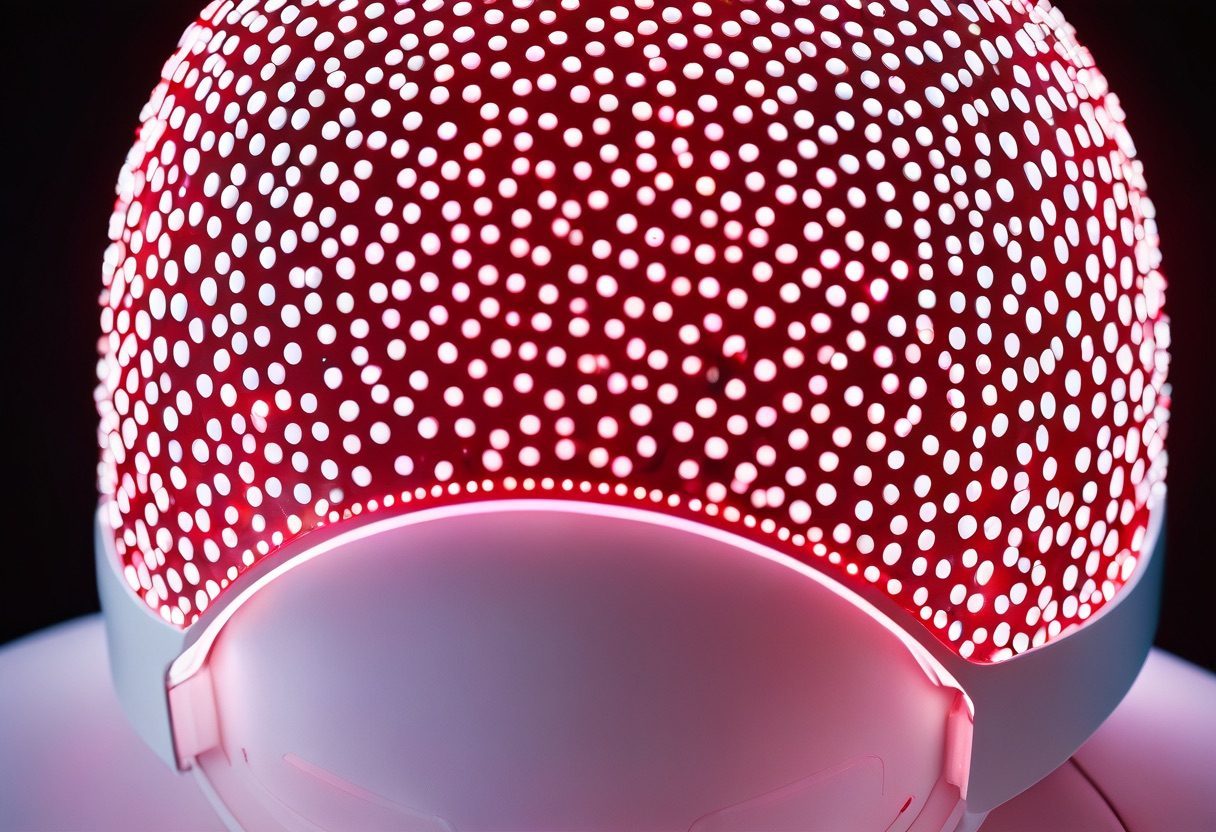
Every trial above used a device built for the scalp: a comb parted through the hair, or a helmet or cap sitting on the head, delivering a set dose at a fixed distance. Wall panels and full-body panels are not cleared under the hair-growth product code, and we found no sham-controlled trial of a panel for hair. Hair also blocks light, which is why combs are moved through it and caps sit against the scalp.
If hair growth is your reason for buying, the closest match to the evidence is a cap, helmet or comb with its own 510(k) clearance under product code OAP. Ask the seller for the K-number and look it up. Our page on red light therapy at home explains the wavelength, power and dose numbers a device should disclose.
Why there is no advertisement here: the red light advertiser we work with sells panels, masks and wraps, and none of those products is cleared for hair growth or was tested in these trials. Placing one here would point you to the wrong device.
Side effects
The trials reported few problems. The Lanzafame trials recorded “no adverse events or side effects”, and the 2014 comb trials found no serious adverse events. The FDA’s adverse-event database holds 38 reports for hair-growth combs and caps, 15 of them coded as injuries; the most common codes were “no clinical signs”, hair loss and headache. Reports cannot show how often problems happen. Our red light therapy dangers page covers eye safety and light-sensitising medicines, which apply to any light device.
Who should see a doctor first
- Hair loss that is sudden, patchy, or all over rather than a receding hairline or thinning crown.
- Hair loss with scalp pain, redness, scaling or scarring.
- Hair loss after childbirth, a serious illness, a new medicine or rapid weight loss.
- Hair loss during chemotherapy: the few light studies are too small to pool, and your oncology team should decide.
- Women with irregular periods, acne or excess facial hair alongside thinning, which can point to a hormonal cause.
Frequently Asked Questions
Does red light therapy work for hair growth?
For pattern hair loss, sham-controlled trials found more hair: about 12 to 41 extra hairs per cm² over 16 to 26 weeks, depending on the device. For other kinds of hair loss there is too little data. In two laser-comb trials in women, participants did not rate the real device better than the sham.
How long does red light therapy take to grow hair?
The trials measured results at 16 to 26 weeks, and a 2025 meta-analysis found a larger effect after 20 weeks than before. Plan on about six months of regular use before judging it.
How often should you use red light therapy for hair?
Trials used schedules from daily to three times a week, often every other day. A 2019 meta-analysis found lower-frequency schedules worked at least as well as higher-frequency ones. Follow the schedule cleared for your device.
Is red light therapy better than minoxidil?
One small 2025 trial in men found no significant difference between 5% minoxidil and red light over six months, with more excellent responses on minoxidil. Minoxidil has the stronger evidence base; light has been tested as an alternative and as an add-on.
Can a red light panel grow hair?
We found no sham-controlled trial of a panel for hair growth. The trials used combs, helmets and caps on the scalp, and those are the devices cleared by the FDA under the hair-growth product code.
Does red light therapy work for alopecia areata?
The evidence is too thin to say. A 2025 meta-analysis found only 50 patients with alopecia areata across its studies and could not pool the results. Patchy hair loss should be diagnosed and treated by a dermatologist.
The Bottom Line
Red light therapy for hair growth has real trial support, but for one condition: pattern hair loss. Caps, helmets and combs used for 16 to 26 weeks increased hair counts over sham devices, and one small trial found them comparable to minoxidil. Whether the gain is visible to the person using it is less certain; in two trials women could not tell the real comb from the fake. If you try it, use a device cleared for hair growth, give it six months, and see a dermatologist first if your hair loss is sudden, patchy or not the usual pattern.
Sources
- Perez SM, Vattigunta M, Kelly C, Eber A. Low-Level Laser and LED Therapy in Alopecia: A Systematic Review and Meta-Analysis. Dermatol Surg, 2025;51(2):179-183. PMID 39404126. 38 studies, 3,098 patients: androgenetic 2,930, scarring 49, alopecia areata 50, telogen effluvium 17, chemotherapy-induced 32; SMD 1.14 under 20 weeks, 1.44 over 20 weeks; other types “statistical information was insufficient for meta-analysis”. Checked 21 October 2026.
- van Zuuren EJ, Fedorowicz Z, Schoones J. Interventions for female pattern hair loss. Cochrane Database Syst Rev, 2016;(5):CD007628. PMID 27225981. Two laser-comb studies, 141 participants: participant-rated RR 1.54 (0.96 to 2.49) and 1.18 (0.74 to 1.89); hair count MD 17.40 and 17.60; minoxidil hair count +13.18 per cm². Checked 21 October 2026.
- Lanzafame RJ, et al. The growth of human scalp hair mediated by visible red light laser and LED sources in males. Lasers Surg Med, 2013;45(8):487-495. PMID 24078483. 44 men, 655 nm helmet, every other day for 16 weeks; 39% hair increase vs placebo; no adverse events. Checked 21 October 2026.
- Lanzafame RJ, et al. The growth of human scalp hair in females using visible red light laser and LED sources. Lasers Surg Med, 2014;46(8):601-607. PMID 25124964. 47 women, same device and schedule; 37% increase vs placebo; no adverse events. Checked 21 October 2026.
- Jimenez JJ, et al. Efficacy and safety of a low-level laser device in the treatment of male and female pattern hair loss: a multicenter, randomized, sham device-controlled, double-blind study. Am J Clin Dermatol, 2014;15(2):115-127. PMID 24474647. 128 men and 141 women randomised; 3 times weekly for 26 weeks; +18.4 to +25.7 terminal hairs per cm² vs +1.6 to +9.4 sham. Checked 21 October 2026.
- Kim H, et al. Low-level light therapy for androgenetic alopecia: a 24-week, randomized, double-blind, sham device-controlled multicenter trial. Dermatol Surg, 2013;39(8):1177-1183. PMID 23551662. 40 subjects, 630/650/660 nm helmet, 18 minutes daily; investigator global assessment significant, “that of the subject did not”. Checked 21 October 2026.
- Yoon JS, et al. Low-level light therapy using a helmet-type device for the treatment of androgenetic alopecia: a 16-week, multicenter, randomized, double-blind, sham device-controlled trial. Medicine (Baltimore), 2020;99(29):e21181. PMID 32702878. 60 participants, 655 nm; +41.90 hairs/cm² vs +0.72 sham. Checked 21 October 2026.
- Thomas M, et al. Clinical Safety and Efficacy of Dual Wavelength Low-Level Light Therapy in Androgenetic Alopecia: A Double-Blind Randomized Controlled Study. Dermatol Surg, 2025;51(4):416-421. PMID 39679573. 160 randomised, 91 excluded from per-protocol; individual arms not significant; pooled 28.5 more hairs per cm² vs sham (p = .033). Checked 21 October 2026.
- Liu KH, et al. Comparative effectiveness of low-level laser therapy for adult androgenic alopecia: a system review and meta-analysis of randomized controlled trials. Lasers Med Sci, 2019;34(6):1063-1069. PMID 30706177. 11 double-blind RCTs; SMD 1.316; low-frequency SMD 1.555 vs high-frequency 0.949. Checked 21 October 2026.
- Adil A, Godwin M. The effectiveness of treatments for androgenetic alopecia: A systematic review and meta-analysis. J Am Acad Dermatol, 2017;77(1):136-141. PMID 28396101. Low-level laser therapy in men, minoxidil and finasteride all superior to placebo. Checked 21 October 2026.
- Gupta AK, et al. Efficacy of non-surgical treatments for androgenetic alopecia: a systematic review and network meta-analysis. J Eur Acad Dermatol Venereol, 2018;32(12):2112-2125. PMID 29797431. LLLT ranked superior; quality of evidence for LLLT vs sham “very low”. Checked 21 October 2026.
- Neema S, et al. Low-level light therapy versus topical 5% minoxidil in the management of androgenetic alopecia in males: A randomised controlled trial. Med J Armed Forces India, 2025;81(4):445-452. PMID 40697690. 91 randomised, 75 completed; 633 nm, 3 times weekly; “no significant difference in the two groups”. Checked 21 October 2026.
- Yang X, et al. Comparative efficacy of 2% minoxidil alone against combination of 2% minoxidil and low-level laser therapy in female pattern hair loss: a randomized controlled trial in Chinese females. Photodiagnosis Photodyn Ther, 2024;45:103966. PMID 38211777. Combination improved mid-scalp hair diameter vs minoxidil alone. Checked 21 October 2026.
- US Food and Drug Administration. openFDA device classification and 510(k) APIs, product code OAP “Laser, Comb, Hair”: definition “Promote hair growth in males with androgenic alopecia and norwood hamilton classification of iia to v”; 115 clearances, 8 dated 2026. open.fda.gov. Queried 21 October 2026.
- US Food and Drug Administration. openFDA device adverse event (MAUDE) API, product code OAP: 38 reports, 15 coded as injury. open.fda.gov. Queried 21 October 2026.