Red Light Therapy Benefits: 4 of 7 Claims Have Strong Trials
Quick Answer: Of seven commonly claimed red light therapy benefits, four have strong trial support and three rest on thin evidence. Red light therapy (the research name is photobiomodulation) shines red or near-infrared light, roughly 600 to 900 nanometres in the trials below, on skin or tissue, and what it does depends on what you use it for. The strongest backing is narrow and clinical: cancer-supportive-care guidelines from MASCC/ISOO recommend specific photobiomodulation protocols to prevent mouth sores in certain cancer treatments. For pattern hair loss, a meta-analysis of 11 double-blind randomised trials found more hair density than sham devices. For knee osteoarthritis and neck pain, meta-analyses found less pain, but at specific laser doses and wavelengths. For wrinkles there is one controlled trial of note; for acne, Cochrane rated most of the evidence very low quality. The common thread: the trials tested defined wavelengths, doses and schedules, often with lasers in clinics, which is not the same thing as a general-wellness panel on a bedroom wall.
“Red light therapy” now covers everything from hospital lasers to LED face masks and full-body panels. Lists of red light therapy benefits tend to present a dozen of them as if they were equally proven. They are not. Below, each use is ranked by the kind of evidence behind it, with the wavelengths and doses the studies actually used, so you can judge whether a given device resembles what was tested.
What is red light therapy?
Photobiomodulation means using low-power red or near-infrared light, from lasers or light-emitting diodes (LEDs), to change how tissue behaves, without heating or burning it. The studies on this page used, for example, 655 nm red light for hair (Lanzafame 2013), 611 to 650 nm red light for skin (Wunsch 2014), and 785 to 860 nm or 904 nm infrared laser light for knee pain (Stausholm 2019). Those numbers matter: the knee meta-analysis found the benefit concentrated in trials that used the doses recommended by the World Association for Laser Therapy, not in every trial that shone a light.
What does red light therapy do? The 7 benefits, ranked
| Use | What the evidence is | What the studies used |
|---|---|---|
| 1. Preventing oral mucositis in some cancer treatments | Guideline recommendation (MASCC/ISOO) for specific settings | Specific clinical protocols; clinicians told to “adhere to all parameters” |
| 2. Pattern hair loss (androgenetic alopecia) | Meta-analysis of 11 double-blind RCTs vs sham | Laser combs and helmets; one trial 655 nm, every other day, 16 weeks |
| 3. Knee osteoarthritis pain | Meta-analysis of 22 placebo-controlled RCTs (1,063 people) | Laser, 4–8 J at 785–860 nm or 1–3 J at 904 nm per spot |
| 4. Neck pain | Meta-analysis of 16 RCTs (820 patients), Lancet 2009 | Low-level laser, various wavelengths |
| 5. Wrinkles and skin roughness | One controlled trial of 136 volunteers | 611–650 nm or 570–850 nm light, about 9 J/cm², 30 sessions |
| 6. Waist circumference | Systematic review of 3 RCTs (160 people); a couple of centimetres | Low-level laser, e.g. 635–680 nm, twice a week for 4 weeks |
| 7. Acne | Cochrane review of 71 studies; most evidence very low quality | Wavelengths, doses and sessions varied widely |
1. Preventing mouth sores during some cancer treatments: a guideline recommendation
This is the only use on the list where an international guideline body recommends photobiomodulation. The Multinational Association of Supportive Care in Cancer and the International Society of Oral Oncology (MASCC/ISOO) reviewed the evidence in 2019 and made “Recommendations … for the prevention of OM and related pain with PBM therapy” in patients treated with haematopoietic stem cell transplantation, head and neck radiotherapy without chemotherapy, and head and neck radiotherapy with chemotherapy.
The recommendation is tightly bounded. The panel recommends “1-2 clinically effective protocols” per setting and says “the clinician should adhere to all parameters of the protocol selected.” For treating mouth sores that have already developed, and for chemotherapy-related mucositis, it found “No Guideline Possible” because of inadequate evidence. This is hospital supportive care, delivered by clinicians to set parameters; it does not translate into a home device recommendation.
2. Pattern hair loss: consistent trial results, and FDA-cleared home devices
Hair loss has the best evidence of any cosmetic use. A 2019 meta-analysis pooled 11 double-blind randomised controlled trials (from 8 studies) comparing low-level laser therapy with sham devices in androgenetic alopecia. Hair density increased more with real devices (standardised mean difference 1.316, 95% CI 0.993 to 1.639), in men and women, with comb-type and helmet-type devices. The authors note the review “was limited by the heterogeneity of included trials.”
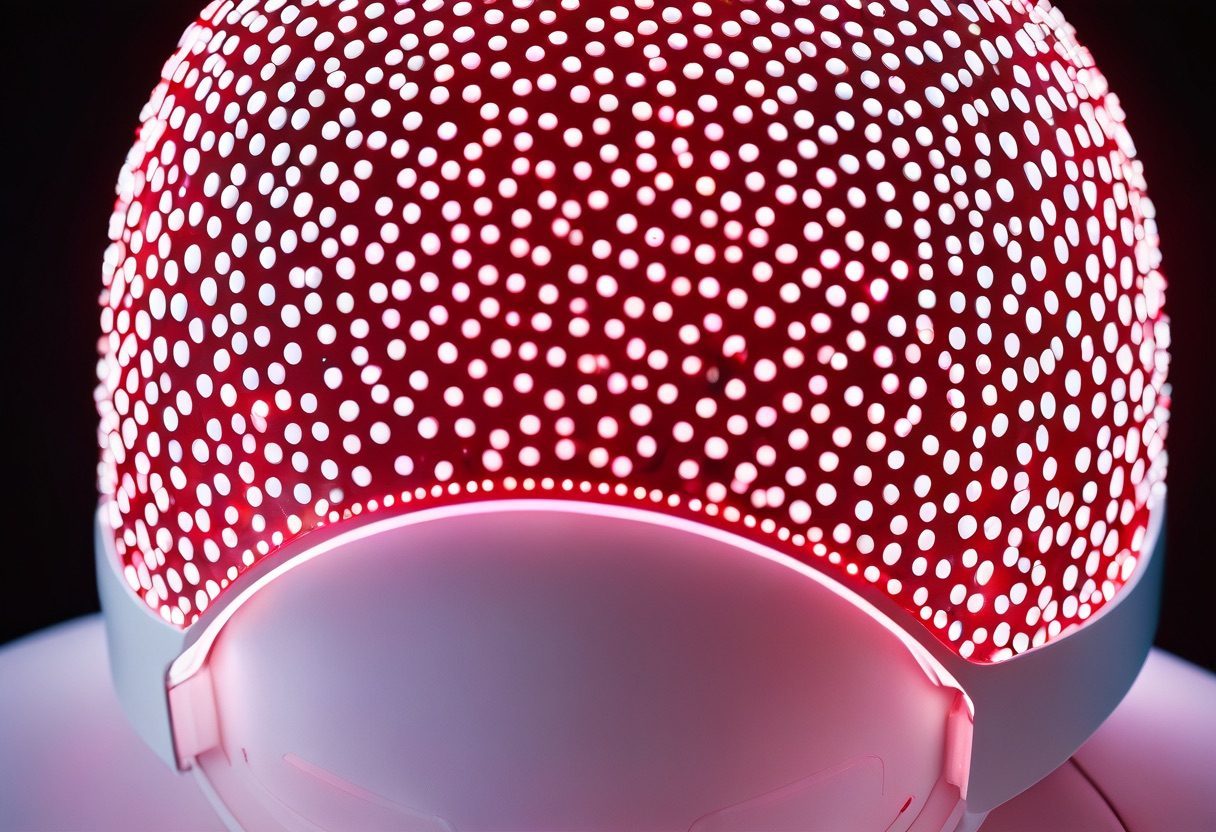
One of the underlying trials shows what was actually used. In a 2013 double-blind trial, 44 men with pattern hair loss used a helmet containing 21 lasers and 30 LEDs at 655 nm, or an identical-looking placebo helmet with incandescent red lights, at home every other day for 16 weeks (60 treatments). Hair counts rose 39% more in the active group, and no adverse events were reported.
These are also the devices with a clear regulatory track. In the FDA’s 510(k) database, product code OAP (“Laser, Comb, Hair”) lists 114 clearances (openFDA, searched 18 October 2026). If hair loss is your reason for buying, a device cleared under that code is the closest match to what the trials tested. Our page on red light therapy for hair growth goes through each trial, what participants themselves reported, and how light compares with minoxidil.
3. Knee osteoarthritis: pain relief, but only at the right dose
A 2019 BMJ Open meta-analysis pooled 22 placebo-controlled trials with 1,063 participants with knee osteoarthritis. Pain fell by 14.23 mm on a 100 mm visual analogue scale more than placebo at the end of therapy. When the authors looked only at trials using doses recommended by the World Association for Laser Therapy, the difference was 18.71 mm at the end of therapy and peaked at 31.87 mm two to four weeks later. Their conclusion is specific: low-level laser therapy “reduces pain and disability in KOA at 4-8 J with 785-860 nm wavelength and at 1-3 J with 904 nm wavelength per treatment spot.”
Two caveats. The same paper opens by noting that low-level laser therapy “is not recommended in major knee osteoarthritis (KOA) treatment guidelines.” And two of its authors are long-standing researchers in laser therapy, which the paper’s competing-interests statement addresses. The doses are per treatment spot from lasers, typically delivered in a clinic, not a whole-body LED panel.
4. Neck pain: a Lancet meta-analysis
A 2009 Lancet meta-analysis identified 16 randomised controlled trials with 820 patients. In acute neck pain, two trials showed a relative risk of 1.69 (95% CI 1.22 to 2.33) for pain improvement with low-level laser therapy versus placebo. In chronic neck pain, five trials gave a relative risk of 4.05, and 11 trials reporting pain scores showed a reduction of 19.86 mm on a 100 mm scale. Side-effects were mild and no different from placebo. These were laser treatments applied to painful sites, across a range of wavelengths.
5. Wrinkles and skin texture: one controlled trial
The study most often cited for skin is a 2014 controlled trial by Wunsch and Matuschka. Of 136 volunteers, 113 were randomised to four treatment groups using 611 to 650 nm red light or broader 570 to 850 nm light (normalised to about 9 J/cm² in the 611 to 650 nm range), twice a week for 30 sessions, and compared with 23 controls. Treated groups improved in skin complexion, roughness and ultrasound-measured collagen density, and blinded photo assessment favoured the treatment groups. The broadband light showed “no advantage over the red-light-only spectrum.” The first author is listed with Medical Light Consulting in Heidelberg.
The FDA has a product code for this use too: OHS (“Light Based Over The Counter Wrinkle Reduction”), with 163 clearances in the 510(k) database, many of them LED masks.
6. Waist circumference: centimetres, not kilograms
A 2025 systematic review found three randomised trials with 160 participants. Low-level laser therapy reduced waist circumference by 2.48 cm compared with 0.635 cm in controls. The authors say varying protocols “make it challenging to determine optimal parameters and long-term efficacy.” In one of the earlier trials, 40 adults had their waistline treated with 635 to 680 nm light for 30 minutes twice a week for 4 weeks, and lost 2.15 cm of girth more than controls; that analysis was limited to people whose body weight stayed within 1.5 kg. This is body contouring of a few centimetres, not weight loss. The FDA product code for fat-reducing low-level lasers (OLI) lists 33 clearances.
7. Acne: Cochrane rated most of the evidence very low quality
The 2016 Cochrane review included 71 studies with 4,211 participants. Light treatments “differed greatly in wavelength, dose” and other factors, most studies were small (median 31 participants), and two thirds were industry-sponsored. For participants’ overall assessment of improvement, Cochrane rated the evidence “very low” for light therapies compared with placebo, no treatment or other treatments. In three trials of red-light photodynamic therapy, the active drug plus red light was no different from placebo cream plus red light for lesion counts (moderate-quality evidence). Light for acne is not a settled treatment.
Does red light therapy work? Why the trials do not automatically cover a home panel
Every positive result above came with a defined wavelength, dose and schedule: 655 nm every other day for hair, 4 to 8 joules per spot at 785 to 860 nm for knees, about 9 J/cm² twice weekly for skin. Many of the pain trials used lasers applied to specific points by a clinician. A general-wellness panel may emit similar wavelengths, but unless its output and your distance and timing reproduce a tested protocol, the trial result is not evidence for that device. The knee meta-analysis makes the point directly: the benefit was concentrated at recommended doses.
Regulatory status is a useful filter. Hair combs and helmets (product code OAP), over-the-counter wrinkle devices (OHS), adjunctive pain lasers (NHN, 54 clearances) and fat-reducing lasers (OLI) all have FDA 510(k) clearance pathways. A device sold only as general wellness has not been through that review for any of these claims.
If you are setting up a panel at home, our guide to red light therapy at home turns a panel’s wavelength, irradiance and session time into the doses these trials used, and sets out how often the trial protocols applied it.
If you are looking at face masks specifically, our red light therapy mask page counts the 65 masks with FDA 510(k) clearances and compares the two sham-controlled mask trials.
Before you buy or use a device, see what is on record about red light therapy dangers: eye injuries from laser devices, skin reports to the FDA, and the drugs that react to red light.
Frequently Asked Questions
What are the benefits of red light therapy?
Four benefits have strong support: preventing mouth sores in specific cancer treatments (a MASCC/ISOO guideline recommendation), more hair density in pattern hair loss, and less pain in knee osteoarthritis and neck pain at specific laser doses. Wrinkle improvement, a few centimetres off the waist, and acne rest on thinner or very low-quality evidence.
What does red light therapy do?
It exposes tissue to low-power red or near-infrared light. The best-supported effects are preventing mouth sores in specific cancer treatments (a MASCC/ISOO guideline recommendation), increasing hair density in pattern hair loss (11 double-blind trials), and reducing knee osteoarthritis and neck pain at specific laser doses.
Does red light therapy work?
For some uses, in trials, yes: hair loss, knee osteoarthritis pain, neck pain and mouth-sore prevention in cancer care have meta-analysis or guideline support. For wrinkles there is one controlled trial; for acne, Cochrane rated most evidence very low quality. Results apply to the wavelengths and doses tested.
What is red light therapy?
It is photobiomodulation: low-level red (about 600 to 700 nm) or near-infrared (about 780 to 900 nm) light from lasers or LEDs, used at intensities that do not heat or burn tissue.
Is red light therapy FDA approved?
Some devices are FDA-cleared for specific uses through the 510(k) process: hair-loss laser combs and helmets (114 clearances under product code OAP), over-the-counter wrinkle devices (163 under OHS) and others. A device sold as general wellness without a 510(k) has not been cleared for those claims.
How often do you do red light therapy?
The trials used different schedules: every other day for 16 weeks in a hair-loss helmet trial, twice a week for 30 sessions in the skin trial. The hair-loss meta-analysis found a larger effect in the lower-frequency treatment group. Follow the schedule tested for your use or your device’s cleared instructions.
Does red light therapy help you lose weight?
The trials measured waist circumference, not body weight: about 2.5 cm off the waist versus 0.6 cm in controls across three small trials. That is body contouring, not weight loss.
Advertisement
FliKEZE SpectraPanel Pro 78. A red and near-infrared LED panel. Its product page lists wavelengths of 630, 660, 810 and 850 nm. This is a paid placement, not a recommendation, and nothing above was tested with this device. The product page says “Verified by FDA”; we found no FDA 510(k) clearance under the FliKEZE or SpectraPanel names (openFDA search, 18 October 2026), so it is sold as a general-wellness device, not a cleared medical device.
Sponsored link — we may earn a commission at no extra cost to you. If you have a medical condition, are pregnant, or take medicines that make you sensitive to light, ask your doctor before using any light device.
The Bottom Line
Red light therapy benefits are real for some uses, but it is not one treatment with many benefits; it is a family of light doses tested for specific problems. The evidence is strongest where the use is narrow and the protocol is defined: preventing mouth sores in certain cancer treatments, regrowing some hair in pattern hair loss, and easing knee and neck pain at set laser doses. For wrinkles it is promising but thin, for waistlines it is a couple of centimetres, and for acne it is mostly very low quality. Before buying a device, match it to a use, check whether it is FDA-cleared for that use, and check whether its wavelength and schedule resemble the trial that made the claim.
Sources
- Zadik Y, et al.; MASCC/ISOO Mucositis Study Group. Systematic review of photobiomodulation for the management of oral mucositis in cancer patients and clinical practice guidelines. Support Care Cancer, 2019;27(10):3969-3983. PMID 31286228. Recommendations for prevention in HSCT, head and neck radiotherapy with or without chemotherapy; “1-2 clinically effective protocols”; “No Guideline Possible” for established OM or chemotherapy-related OM. Checked 18 October 2026.
- Liu KH, et al. Comparative effectiveness of low-level laser therapy for adult androgenic alopecia: a system review and meta-analysis of randomized controlled trials. Lasers Med Sci, 2019;34(6):1063-1069. PMID 30706177. 8 studies, 11 double-blind RCTs; SMD 1.316 (95% CI 0.993 to 1.639); limited by heterogeneity. Checked 18 October 2026.
- Lanzafame RJ, et al. The growth of human scalp hair mediated by visible red light laser and LED sources in males. Lasers Surg Med, 2013;45(8):487-495. PMID 24078483. 44 men; 655 nm; every other day for 16 weeks, 60 treatments; 39% increase; no adverse events. Checked 18 October 2026.
- Stausholm MB, et al. Efficacy of low-level laser therapy on pain and disability in knee osteoarthritis: systematic review and meta-analysis of randomised placebo-controlled trials. BMJ Open, 2019;9(10):e031142. PMID 31662383. 22 trials, 1,063 participants; 14.23 mm, 18.71 mm and 31.87 mm VAS; 4-8 J at 785-860 nm, 1-3 J at 904 nm; “not recommended in major knee osteoarthritis (KOA) treatment guidelines”. Checked 18 October 2026.
- Chow RT, et al. Efficacy of low-level laser therapy in the management of neck pain: a systematic review and meta-analysis. Lancet, 2009;374(9705):1897-1908. PMID 19913903. 16 RCTs, 820 patients; RR 1.69 (1.22 to 2.33) acute; RR 4.05 chronic; 19.86 mm. Checked 18 October 2026.
- Wunsch A, Matuschka K. A controlled trial to determine the efficacy of red and near-infrared light treatment in patient satisfaction, reduction of fine lines, wrinkles, skin roughness, and intradermal collagen density increase. Photomed Laser Surg, 2014;32(2):93-100. PMID 24286286. 136 volunteers, 113 treated and 23 controls; 611-650 nm or 570-850 nm, about 9 J/cm², 30 sessions. Checked 18 October 2026.
- Mustafa GA, et al. Low-level laser therapy for reducing body circumferences: a systematic review. Lasers Med Sci, 2025;40(1):534. PMID 41423522. 3 RCTs, 160 participants; waist 2.48 cm vs 0.635 cm. Checked 18 October 2026.
- Caruso-Davis MK, et al. Efficacy of low-level laser therapy for body contouring and spot fat reduction. Obes Surg, 2011;21(6):722-729. PMID 20393809. 40 adults; 635-680 nm; 30 minutes twice a week for 4 weeks; 2.15 cm; analysis limited to body weight within 1.5 kg. Checked 18 October 2026.
- Barbaric J, et al. Light therapies for acne. Cochrane Database Syst Rev, 2016;9:CD007917. PMID 27670126. 71 studies, 4,211 participants; median 31 participants; two thirds industry-sponsored; evidence very low for participant-assessed improvement; MAL-PDT red light no different from placebo cream plus red light for lesion counts. Checked 18 October 2026.
- U.S. Food and Drug Administration, 510(k) premarket notification database via openFDA. Product codes OAP “Laser, Comb, Hair” (114 clearances), OHS “Light Based Over The Counter Wrinkle Reduction” (163), NHN adjunctive pain laser (54), OLI “Fat Reducing Low Level Laser” (33); no results for “FliKEZE” or “SpectraPanel”. open.fda.gov. Checked 18 October 2026.
- FliKEZE SpectraPanel Pro 78 product page: wavelengths 630, 660, 810, 850 nm; “Verified by FDA”. flikeze.com. Checked 18 October 2026.