Red Light Therapy Mask: 65 FDA Clearances, 2 Sham Trials Disagree
Quick Answer: A red light therapy mask is an LED face mask that shines red and usually near-infrared light on the skin, sold mainly for wrinkles and, in blue-light versions, for acne. On 18 October 2026 the FDA’s 510(k) database listed 57 masks cleared under the over-the-counter wrinkle-reduction code and 8 under the over-the-counter acne code, 65 in all, and 35 of the 57 wrinkle masks were cleared in 2025 or 2026. A clearance is not an approval: it means FDA accepted that the device is substantially equivalent to one already on the market for that specific use. The evidence for masks themselves is thin and split. In one sham-controlled trial of 60 adults, a 630/850 nm mask improved crow’s feet over 16 weeks; in another of 95 women, blinded specialists found no difference from sham on their wrinkle scale after four weeks of a 660 nm mask. Ask any seller for the mask’s K-number before you buy. An advertisement for one mask is in the box near the end of this page.
Our red light therapy benefits page covers what red light does across seven uses, from hair loss to knee pain. This page is narrower: what a face mask is, what the FDA has and has not cleared, and what the trials of masks specifically found.
What a red light therapy mask is
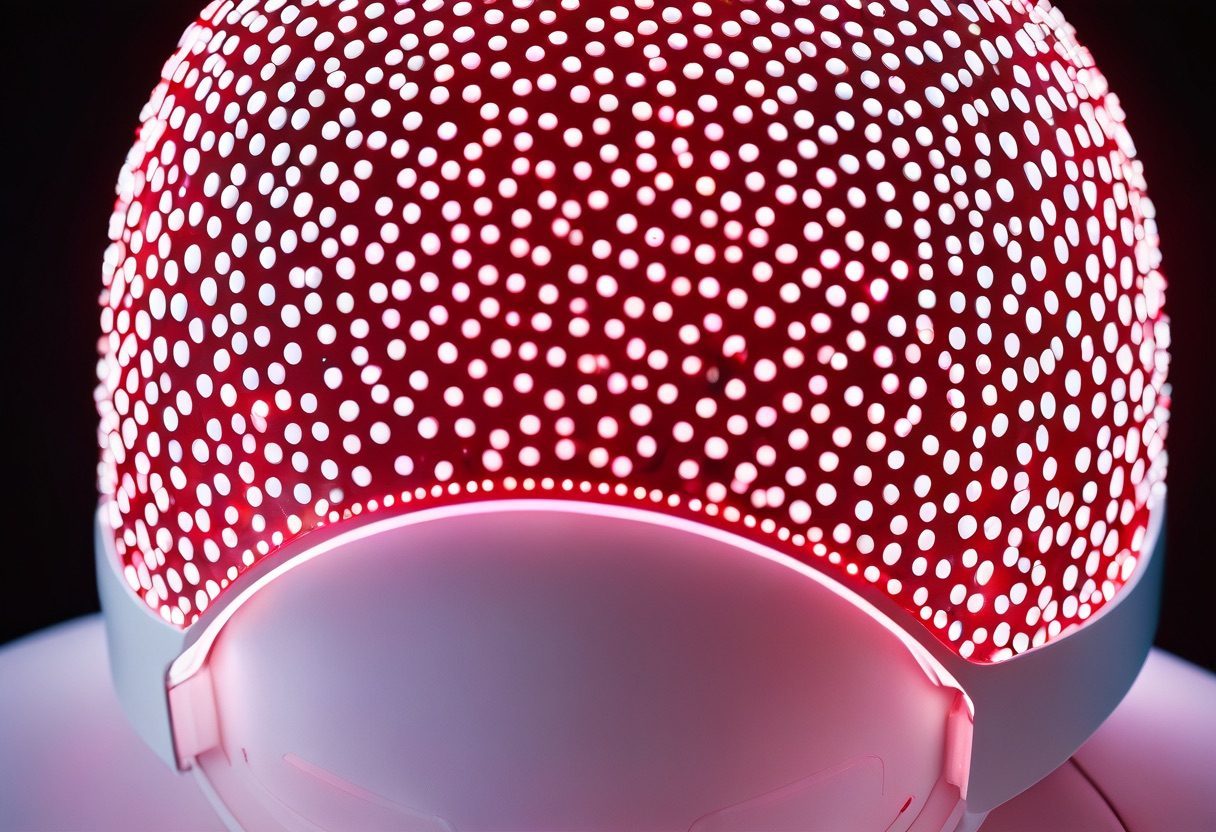
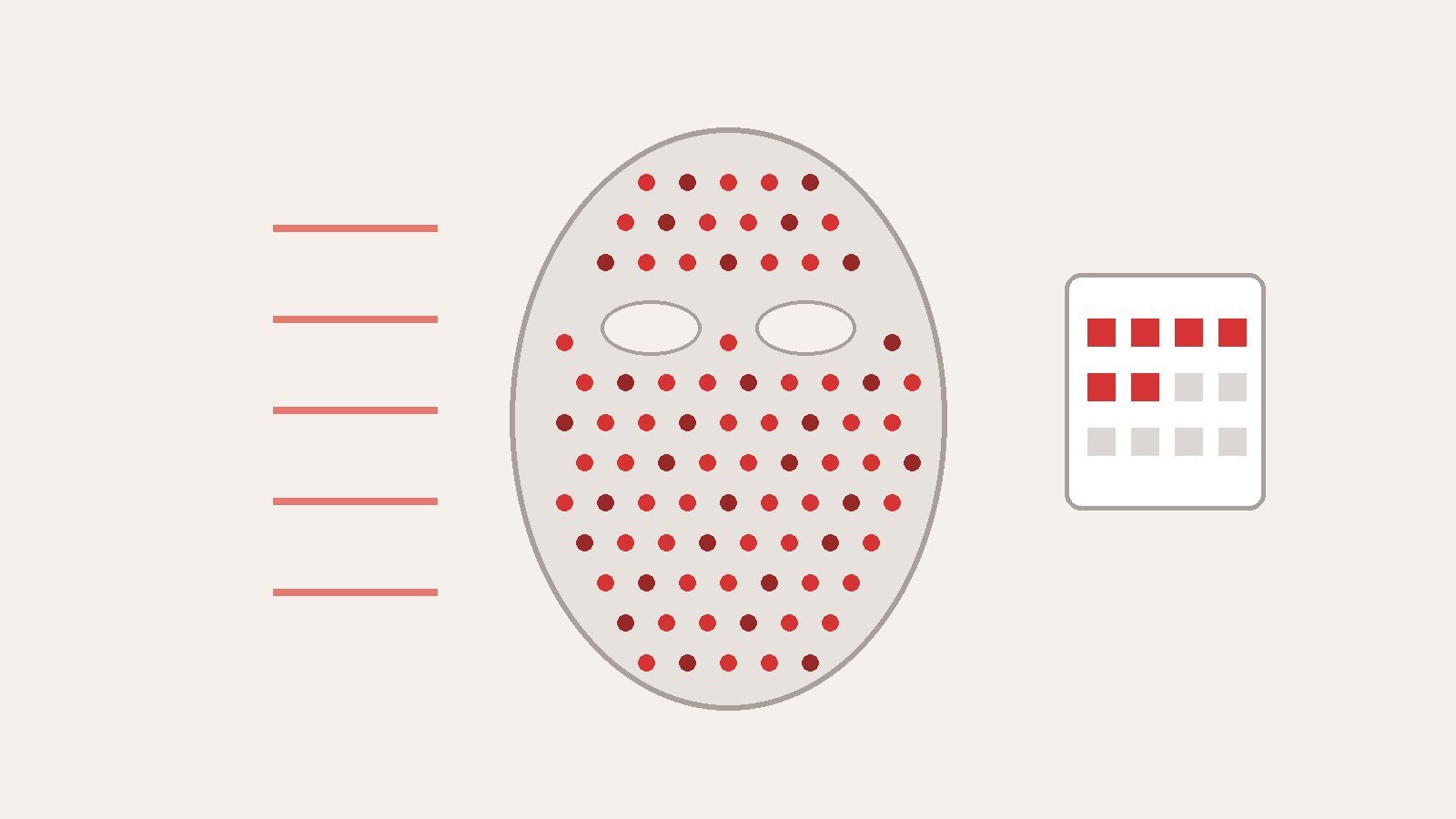
A red light therapy mask is a rigid or flexible shell lined with light-emitting diodes (LEDs) that sits over the face, for sessions of several minutes at a time; one of the trials below used 21-minute sessions, and the product in the box below lists 10 to 15 minutes. Most current masks combine several colours. Red light (roughly 630 to 660 nm) and near-infrared light (roughly 830 to 850 nm) are marketed for wrinkles and skin tone; blue light (around 415 nm) is marketed for acne. Many masks also add yellow, green or other colours.
The light levels are low. The two controlled mask trials described below used devices at around 6 to 10 mW/cm², far below the lasers used in clinics for some of the conditions on our benefits page. That matters, because a mask’s results cannot be borrowed from laser studies.
What the FDA has cleared: 65 masks, mostly since 2025
We downloaded every record in FDA’s 510(k) database for two product codes on 18 October 2026. Code OHS is defined by FDA as “Use of light based treatment to reduce wrinkles on the body in general or specific anatomical locations”; it is a Class II device code. Code OLP covers over-the-counter acne light devices.
| FDA product code | All records | Records with “mask” in the device name |
|---|---|---|
| OHS (over-the-counter wrinkle reduction) | 163 | 57 |
| OLP (over-the-counter acne) | 51 | 8 |
| Total | 214 | 65 |
Three things stand out in the 57 wrinkle-mask records:
- The rush is recent. 19 were cleared in 2025 and 16 so far in 2026, so 35 of the 57 (61%) date from the last two years. The earliest, the Pulsaderm Wrinkle Mask and the LG Beauty LED Mask, were cleared in 2017.
- Most applicants are factories. 40 of the 57 applicants list China as their country. Shenzhen Kaiyan Medical Equipment holds 6 mask clearances, and some carry brand names you might shop for: the CurrentBody LED 4 in 1 Zone Facial Mapping Mask (K242593), the CurrentBody Skin LED Light Therapy Mask Series 2 (K250966) and the HIGHERDOSE Red and Infrared Light Mask (K241933) are all filed under Shenzhen Kaiyan’s name.
- Not every “mask” is for the face. At least five of the 57 are neck, décolleté, chest or lip devices.
Some recent clearances, as listed in FDA’s database:
| K-number | Cleared | Applicant | Device name (as filed) |
|---|---|---|---|
| K260767 | 31 Aug 2026 | Kam Yuen Plastic Products, Ltd. | Facial Beauty Device (Facial Mask LED Beauty Device A-901) |
| K260715 | 3 Jun 2026 | The Beauty Tech Group, Ltd. | CurrentBody Skin LED Multi Light Therapy Mask (MK-110D) |
| K260415 | 12 May 2026 | Light Tree Ventures Europe B.V. | myLEDmask 2 (MJ-144) |
| K261407 | 15 Jul 2026 | Dongguan Miqiang Technology Co., Ltd. | XPREEN LED Light Therapy Masks |
| K252264 | 17 Oct 2025 | Shenzhen Zhenxing Ruitong Technology Co. | MEGELIN LED Light Therapy Mask |
| K180847 | 19 Jun 2018 | Johnson & Johnson Consumer, Inc. | Neutrogena Light Therapy Acne Mask+ (acne code OLP) |
Cleared is not approved
FDA’s own consumer guidance draws the line. It explains that makers of moderate-risk (Class II) devices “may market such devices pursuant to so-called ‘510(k) clearance,’ allowing distribution once the manufacturer has demonstrated that the device is substantially equivalent to a legally marketed predicate device that does not require premarket approval.” A clearance is also tied to the use in the filing: a mask cleared under the wrinkle code is cleared for wrinkles, not for acne, mood or “skin health” in general.
Because the applicant is often the factory, a brand name may not appear anywhere in the database even when the device is cleared. The only reliable check is the K-number: ask the seller for it, then look it up in FDA’s 510(k) database and confirm the device name and use match what you are being sold.
What the mask trials found
Most published red light studies used panels, lasers or clinic devices. Studies of masks themselves are few, and the two that compared a mask with a sham device point in different directions.
| Study | Design | Device and dose | Result |
|---|---|---|---|
| Park 2025 | Randomized, double-blind, sham-controlled, 2 centers, 60 adults aged 30 to 65 with crow’s feet | 630 nm LED + 850 nm infrared, max 10 mW/cm², 16 weeks | Crow’s feet scores improved more than sham at 8, 12 and 16 weeks; improvement rate 86.2% (full analysis set) |
| Bragato 2025 | Randomized, double-blind, sham-controlled, 95 women aged 45 to 60 | 660 nm red LED mask, 6.4 mW/cm², 8.05 J/cm², 21 minutes, 2 or 3 sessions a week for 4 weeks | No significant difference from sham on the Wrinkle Assessment Scale scored by three blinded specialists; shorter glabellar and right periorbital wrinkles on software image analysis; higher satisfaction |
| Mineroff 2023 | Men using a commercial mask for 6 weeks; the abstract describes no sham or control group | 633, 830 and 1072 nm | Participants reported satisfaction; photo analysis showed improvements |
| Wunsch 2014 | Controlled trial, 136 volunteers (whole-body devices, not a mask) | 611 to 650 nm, about 9 J/cm², 30 sessions | Significantly improved skin complexion, roughness and ultrasound-measured collagen density |
Read together, the mask evidence is two sham-controlled trials of fewer than 100 people each, one positive on its main score and one negative on its main specialist score, plus uncontrolled user studies. Bragato’s authors also found that 12 sessions did no better than 8. None of these trials tested the mask in the box below.
Acne masks
The Cochrane review of light therapies for acne (71 studies, 4,211 people), covered on our benefits page, rated the quality of the evidence as low or very low for most comparisons, and found little or no difference in lesion counts between red-light photodynamic therapy and red light with a placebo cream (moderate-quality evidence). A 2026 letter in the International Journal of Dermatology examined how widely the specifications of at-home red and blue LED acne masks sold in the US differ; we could read only its title, so we cite nothing beyond its subject.
Eyes: one case report, and what it does and does not show
In 2026, ophthalmologists described a 43-year-old woman who developed acute angle-closure in both eyes after two weeks of using a red light therapy mask, including on the morning she presented. The authors wrote that choroidal effusions “have not been previously described in association with at-home RLT mask use”, and her vision returned to 20/20 after she stopped using the mask and was treated. A single case cannot show that the mask caused the problem, but it is the reason to stop and see an eye doctor promptly if your vision changes or your eyes hurt during a course of mask use.
A separate small study pointed the other way: 20 women with dry eye who used an LED beauty mask on alternate days for three weeks had improved tear-film measurements. It was a retrospective study with no control group.
We did not find an FDA consumer page specific to LED face masks. Follow your mask’s instructions on eye protection, and do not look directly into the LEDs.
How to read a mask listing before you buy
- Ask for the K-number. If the seller cannot give one, the mask is not shown to be cleared, whatever the listing says.
- Check the use. Wrinkle clearance (code OHS) and acne clearance (code OLP) are different filings.
- Check the wavelengths. The positive sham-controlled trial used 630 and 850 nm; the negative one used 660 nm alone. A long list of colours is not evidence by itself.
- Expect a commitment. The trials ran 4 to 16 weeks of repeated sessions.
Advertisement
FliKEZE PhotonMask Quint. An LED face mask whose product page lists red 660 nm, near-infrared 850 nm, yellow 590 nm, green 532 nm and blue 415 nm, with sessions of 10 to 15 minutes. This is a paid placement, not a recommendation, and none of the trials above tested it. We found no 510(k) record under the FliKEZE or PhotonMask names (openFDA search, 18 October 2026); devices can be cleared under a manufacturer’s name, so ask the seller for the K-number before you buy.
Sponsored link — we may earn a commission at no extra cost to you. If you have an eye condition, take light-sensitizing medicines, or have a skin condition, ask your doctor before using a light therapy mask.
Frequently Asked Questions
Do red light therapy masks work?
The direct evidence is limited. One sham-controlled trial of 60 adults found a 630/850 nm mask improved crow’s feet over 16 weeks; another of 95 women found no difference from sham on the main wrinkle scale scored by blinded specialists after four weeks of a 660 nm mask. Neither tested every mask on the market.
Are red light therapy masks FDA approved?
No mask is FDA “approved”. On 18 October 2026, 65 masks held 510(k) clearances: 57 under the over-the-counter wrinkle-reduction code and 8 under the acne code. A clearance means FDA accepted the device as substantially equivalent to an existing device for that use.
What is the best red light therapy mask?
No trial has compared masks against each other, so there is no evidence-based “best”. The checks that matter are a K-number you can look up, a cleared use that matches what you want, and wavelengths similar to those tested (630 to 660 nm red, around 850 nm near-infrared).
How long does it take for a red light mask to work?
The trials ran 4 to 16 weeks. In the positive trial, differences from sham appeared at 8 weeks and continued to 16 weeks.
Are red light therapy masks safe for your eyes?
One 2026 case report described acute angle-closure in both eyes in a woman using a mask, which resolved after she stopped and was treated; a single case does not prove cause. Follow the device’s eye-protection instructions and stop and see an eye doctor if you notice eye pain or changes in vision.
Can a red light mask treat acne?
Some masks add blue light and hold acne clearances (code OLP). The Cochrane review of light therapies for acne rated the evidence low or very low quality, so a mask is not a substitute for proven acne treatments.
The Bottom Line
Red light therapy masks are now mostly FDA-cleared factory products, with 35 of the 57 wrinkle-mask clearances issued since 2025, but a clearance is a statement about equivalence for one use, not proof that the mask works. The two sham-controlled mask trials disagree, both are small, and neither tested the masks most people buy. If you try one, check the K-number and the cleared use, choose red and near-infrared wavelengths close to those tested, and judge it over months rather than weeks.
Sources
- U.S. Food and Drug Administration. 510(k) Premarket Notification database via openFDA (api.fda.gov/device/510k.json), product codes OHS and OLP. All 163 OHS and 51 OLP records downloaded; 57 and 8 have “mask” in the device name; 19 OHS mask clearances in 2025 and 16 in 2026; 40 of 57 OHS mask applicants list China; 6 OHS mask clearances to Shenzhen Kaiyan Medical Equipment, including K242593 and K250966 (CurrentBody) and K241933 (HIGHERDOSE); earliest 2017. No records for “FliKEZE” or “PhotonMask”. open.fda.gov. Checked 18 October 2026.
- U.S. Food and Drug Administration. Device classification, product code OHS: “Use of light based treatment to reduce wrinkles on the body in general or specific anatomical locations”; Class 2. accessdata.fda.gov. Checked 18 October 2026.
- U.S. Food and Drug Administration. Is It Really “FDA Approved”? Class II devices “may market such devices pursuant to so-called ‘510(k) clearance'”. fda.gov. Checked 18 October 2026.
- Park SH, Park SO, Jung JA. Clinical study to evaluate the efficacy and safety of home-used LED and IRED mask for crow’s feet: a multi-center, randomized, double-blind, sham-controlled study. Medicine (Baltimore), 2025;104(7):e41596. 60 participants; 630 nm LED and 850 nm IRED, max 10 mW/cm²; 16 weeks; significant differences at 8, 12 and 16 weeks; improvement rate 86.2% (FAS). PMID 39960921. Checked 18 October 2026.
- Bragato EF, et al. Role of photobiomodulation application frequency in facial rejuvenation: randomized, sham-controlled, double-blind, clinical trial. Lasers Med Sci, 2025;40(1):170. 95 women aged 45 to 60; 660 nm, 6.4 mW/cm², 8.05 J/cm², 21 min; 12 vs 8 sessions over 4 weeks; “No significant differences among the groups were found with regards to the WAS”. PMID 40167796. Checked 18 October 2026.
- Mineroff J, et al. Male facial rejuvenation using a combination 633, 830, and 1072 nm LED face mask. Arch Dermatol Res, 2023;315(9):2605-2611. 6 weeks; participant-reported satisfaction and photographic analysis. PMID 37418018. Checked 18 October 2026.
- Wunsch A, Matuschka K. A controlled trial to determine the efficacy of red and near-infrared light treatment in patient satisfaction, reduction of fine lines, wrinkles, skin roughness, and intradermal collagen density increase. Photomed Laser Surg, 2014. 136 volunteers; 611 to 650 nm; about 9 J/cm²; 30 sessions. PMID 24286286. Checked 18 October 2026.
- Barbaric J, et al. Light therapies for acne. Cochrane Database Syst Rev, 2016. 71 studies, 4,211 participants; quality rated very low for light therapies versus placebo for the main outcome; moderate-quality evidence of little or no difference in lesion counts between the PDT comparisons. PMID 27670126. Checked 18 October 2026.
- Ershadi S, et al. Heterogeneity in Specifications of At-Home Red and Blue LED Masks for Acne Treatment in the U.S. Market. Int J Dermatol, 2026;65(3):590-592 (title only; no abstract available to us). PMID 40928107. Checked 18 October 2026.
- Labkovich M, et al. A rare acute presentation of simultaneous bilateral angle closure in a patient using a red light therapy mask. Am J Ophthalmol Case Rep, 2026;43:102645. 43-year-old woman; two weeks of mask use; returned to 20/20 after cessation and treatment. PMID 42620457. Checked 18 October 2026.
- Scuderi L, et al. Home-based low-level light therapy using a commercial LED mask for dry eye disease. Int Ophthalmol, 2026;46(1):356. Retrospective, 20 postmenopausal women, alternate days for 3 weeks. PMID 42667448. Checked 18 October 2026.
- FliKEZE. PhotonMask Quint product page: wavelengths 660, 850, 590, 532 and 415 nm; sessions of 10 to 15 minutes. flikeze.com. Checked 18 October 2026.