How Much Bone Broth Per Day? What 175 Labels Show
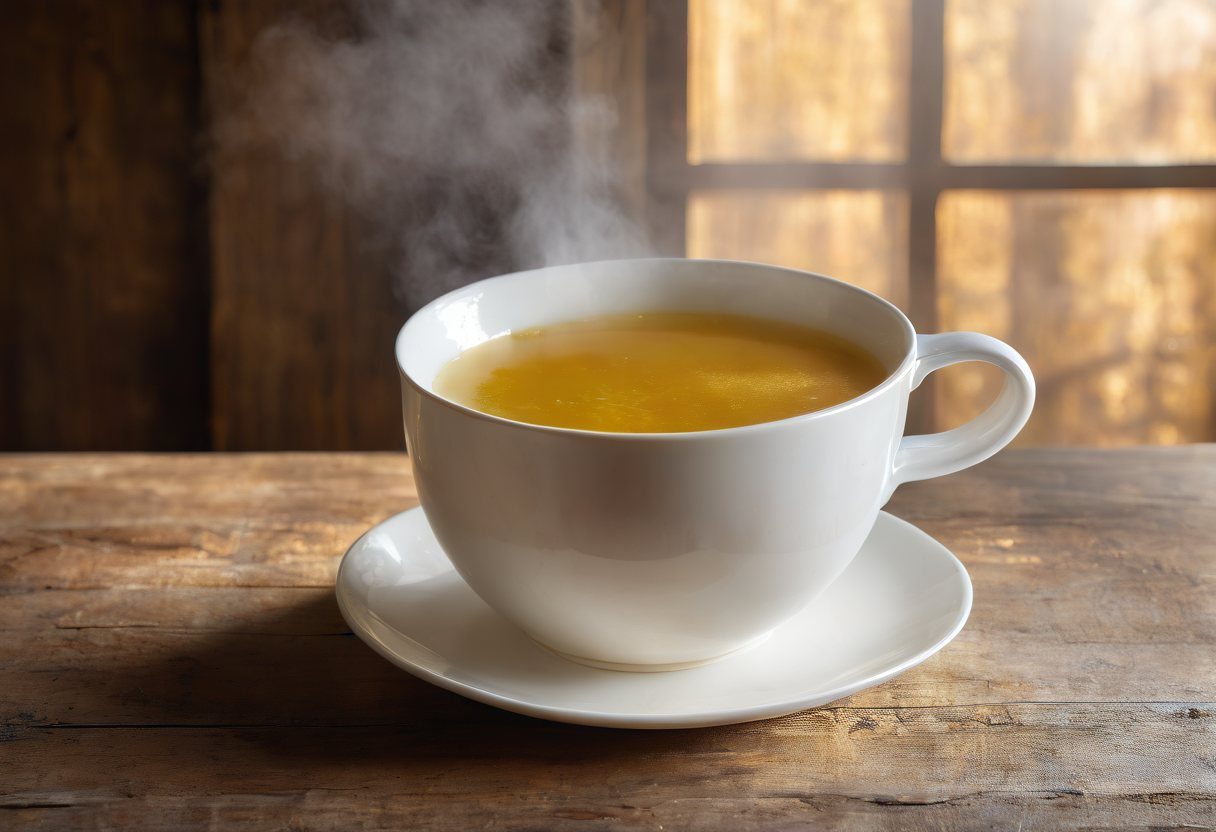
Quick Answer: There is no recommended amount of bone broth, because no clinical trial has tested bone broth itself for a health outcome in people. Treat it as a food: one to two cups a day fits comfortably in most diets. The limit that actually matters is sodium. Across 175 US bone broths in the USDA’s branded food database, a cup had a median of 9 g of protein and 326 mg of sodium, and 30% had 400 mg of sodium or more, with one reaching 1,214 mg. Three cups of a typical brand add about 1,000 mg of sodium, close to half the 2,300 mg daily limit. Bone broth is also not a dependable collagen supplement: a 2019 lab study found its collagen building blocks were lower and far more variable than the 20 g collagen doses used in research. If you make it at home, a small 2013 study found chicken bone broth had several times the lead of the water it was made with, which is a reason to vary your foods rather than drink it by the quart.
Bone broth has a reputation that runs well ahead of its evidence. It is a perfectly good food, warm, filling and low in calories. The questions worth answering are how much protein it really gives you, how much salt comes with it, and whether the collagen claims hold up.
Is there a recommended amount?
No. There is no Dietary Reference Intake for bone broth, and we found no randomized trial that gave people bone broth and measured a health outcome. A 2025 review in Digestive Diseases and Sciences by Matar, Abdelnaem and Camilleri makes the case for bone broth and gut health, but its evidence comes from studies of individual nutrients found in broth, such as glutamine and glycine, and from animal work, not from trials of broth itself.
The “one to two cups a day” advice that circulates online is a reasonable food amount, not a tested dose. What sets the practical ceiling is what comes with each cup.
What a cup of store-bought bone broth contains
We pulled every branded product with “bone broth” in its description from the USDA’s FoodData Central database, kept ready-to-drink broths with a cup-sized serving, and removed powders, soups, noodles, snacks and pet products. That left 175 products from 61 companies. The database stores values per 100 g, which we converted to a 240 g cup.
| Per cup (240 g) | Median | Middle 80% of products | Range |
|---|---|---|---|
| Protein | 9.0 g | 4.8 to 10.6 g | 2.0 to 19.0 g |
| Sodium | 326 mg | 106 to 547 mg | 53 to 1,214 mg |
- Protein: 57 of the 175 products gave 10 g or more per cup, while 19 gave under 5 g. Many flavored broths, such as lemon-thyme or tom yum, were at the low end.
- Sodium: 53 products (30%) had 400 mg or more per cup, and 6 had 600 mg or more. Only 23 had 140 mg or less, the FDA’s threshold for a “low sodium” label per reference serving.
The label, not the word “bone,” tells you what you are getting. Two broths on the same shelf can differ fivefold in protein and tenfold in sodium.
Sodium sets the limit
The Dietary Guidelines advise adults to keep sodium under 2,300 mg a day, and most Americans already go over. At the median of 326 mg per cup, two cups add about 650 mg and three cups about 1,000 mg. A high-sodium brand at 550 mg a cup doubles that. If you drink bone broth daily, the easiest improvement is choosing a lower-sodium product; our guide to how much sodium per day covers the limit and why it matters.
Does bone broth give you collagen?
The protein in bone broth comes largely from gelatin, which is cooked collagen, so the idea is plausible. The question is how much and how consistently.
In a 2019 study in the International Journal of Sport Nutrition and Exercise Metabolism, Alcock, Shaw and Burke measured the key collagen amino acids (glycine, proline, hydroxyproline, hydroxylysine, lysine and leucine) in commercial, homemade and café bone broths. Broth made to a standard recipe had significantly lower levels of all of them than a 20 g dose of the collagen supplements used in research. Broths made to non-standard recipes varied widely, with café versions the highest, and commercial broths were lower than homemade ones. The authors concluded that, even if collagen intake turns out to help build new collagen, bone broth is unlikely to be a consistently reliable source.
Whether eating collagen helps skin or joints at all is a separate question, covered in our look at what the collagen evidence shows. For bone broth, the honest summary is that it contains some collagen protein, in amounts you cannot predict from the label.
The lead question
Bones store lead, and slow simmering can release it. In a small, blinded study published in Medical Hypotheses in 2013, Monro and colleagues measured lead in three organic chicken broths. Broth made from chicken bones had 7.01 µg of lead per liter and broth made from skin and cartilage 9.5 µg per liter, against 0.89 µg per liter for tap water prepared the same way.
For scale, by our calculation a 240 mL cup at 9.5 µg per liter contains about 2.3 µg of lead. The FDA’s interim reference levels for lead from food are 2.2 µg a day for children and 8.8 µg a day for women of childbearing age, and the FDA stresses that no safe level of lead exposure has been identified. One study of three broths cannot tell you how much lead is in yours, and it is not a reason to fear an occasional cup. It is a reason not to make bone broth a large, daily staple for children or during pregnancy.
Who should be careful
- People told to limit sodium, including many with high blood pressure, heart failure or kidney disease. Check the label, or make broth at home without salt.
- People with kidney disease, who may also be on a protein or potassium limit; ask your care team before drinking broth daily.
- Children and pregnant women, because of the lead question above.
We do not link to any product on this page. Bone broth does not need a special brand; it needs a label read for sodium.
Frequently Asked Questions
How much bone broth should you drink a day?
There is no tested amount. As a food, one to two cups a day is reasonable for most people. The practical limit is sodium: a typical store-bought cup has about 326 mg, so several cups a day can use up a large share of the 2,300 mg daily limit.
How much protein is in a cup of bone broth?
About 9 g in a typical store-bought broth, based on the median of 175 products in the USDA branded food database. Most were between about 5 and 11 g per cup, and a few flavored broths had as little as 2 g.
Is bone broth a good source of collagen?
Not a reliable one. A 2019 study found the collagen amino acids in bone broth made to a standard recipe were significantly lower than in a 20 g research dose of collagen supplement, and varied widely between recipes.
Is it OK to drink bone broth every day?
For most healthy adults, a cup a day is fine as part of a normal diet. Choose a lower-sodium product if you drink it daily, and be more cautious with large daily amounts for children or during pregnancy because of the possible lead content.
Does bone broth help your gut?
It has not been tested in human trials. Reviews point to nutrients in broth, such as glutamine and glycine, that are studied for gut barrier function, but no trial has shown that drinking bone broth itself improves gut health.
Is homemade bone broth better than store-bought?
It can be higher in collagen amino acids, according to the 2019 study, and you control the salt. A small 2013 study did find more lead in homemade chicken broths than in plain water, so variety in what you eat is sensible either way.
The Bottom Line
Bone broth is a good, low-calorie food, not a supplement with a dose. One to two cups a day is reasonable. A typical store-bought cup gives about 9 g of protein and 326 mg of sodium, so read the label and let sodium set your limit. Do not rely on it for collagen, and do not make it a large daily staple for children or in pregnancy.
Sources
- USDA Agricultural Research Service. FoodData Central, Branded Foods, API search for “bone broth” (all words), queried 27 September 2026: 423 records; our analysis kept 175 ready-to-drink bone broths with serving size of at least 180 g from 61 brand owners, excluding powders, soups, noodles, snacks and pet products; values per 100 g converted to 240 g. Protein per cup: median 9.0 g, 10th-90th percentile 4.8-10.6 g, range 2.0-19.0 g; 57 with 10 g or more, 19 under 5 g. Sodium per cup: median 326 mg, 10th-90th percentile 106-547 mg, range 53-1,214 mg; 53 at 400 mg or more, 6 at 600 mg or more, 23 at 140 mg or less. fdc.nal.usda.gov.
- Alcock RD, Shaw GC, Burke LM. Bone broth unlikely to provide reliable concentrations of collagen precursors compared with supplemental sources of collagen used in collagen research. International Journal of Sport Nutrition and Exercise Metabolism, 2019;29(3):265-272. PMID 29893587. Standardized-recipe broths significantly lower in glycine, proline, hydroxyproline, hydroxylysine, lysine and leucine than a 20 g dose of reference collagen supplements; large variability across non-standardized recipes. Checked 27 September 2026.
- Monro JA, Leon R, Puri BK. The risk of lead contamination in bone broth diets. Medical Hypotheses, 2013;80(4):389-390. PMID 23375414. Three organic chicken broths; 9.5 and 7.01 µg/L lead vs 0.89 µg/L in tap water control. Checked 27 September 2026.
- US Food and Drug Administration. Lead in Food and Foodwares: interim reference levels of 2.2 µg/day for children and 8.8 µg/day for females of childbearing age, based on the CDC blood lead reference value of 3.5 µg/dL with a 10x safety factor; no safe level of lead exposure has been identified. fda.gov. Checked 27 September 2026.
- Matar A, Abdelnaem N, Camilleri M. Bone broth benefits: how its nutrients fortify gut barrier in health and disease. Digestive Diseases and Sciences, 2025;70:1951-1961. PMID 40180691. Narrative review of broth components (glutamine, glycine, proline, minerals) from animal and human studies. Checked 27 September 2026.
- US Department of Agriculture and US Department of Health and Human Services. Dietary Guidelines for Americans: sodium under 2,300 mg per day for adults. FDA nutrient content claims (21 CFR 101.61): “low sodium” means 140 mg or less per reference amount. dietaryguidelines.gov. Checked 27 September 2026.