How Much Celtic Salt Per Day? The Same Limit as Table Salt
Quick Answer: Celtic salt counts toward the same sodium limit as any other salt: under 2,300 mg of sodium a day from all sources for adults. According to the brand’s own label data in the USDA database, light grey Celtic Sea Salt has 32,000 mg of sodium per 100 g, against 38,800 mg for table salt, so it is about 17% lower in sodium by weight, and a quarter teaspoon gives about 480 mg of sodium instead of about 580 mg. That difference is real but small: the entire daily limit equals roughly 1 1/4 teaspoons of Celtic salt, and most Americans already exceed the limit from food before adding any. The “trace minerals” are too small to matter. The one Celtic Sea Salt product whose label lists magnesium gives about 8 mg per quarter teaspoon; reaching a man’s 420 mg magnesium target from it would take about 71 g of salt and some 20,000 mg of sodium. Celtic salt is also not iodized, so if it replaces iodized salt, get iodine elsewhere.
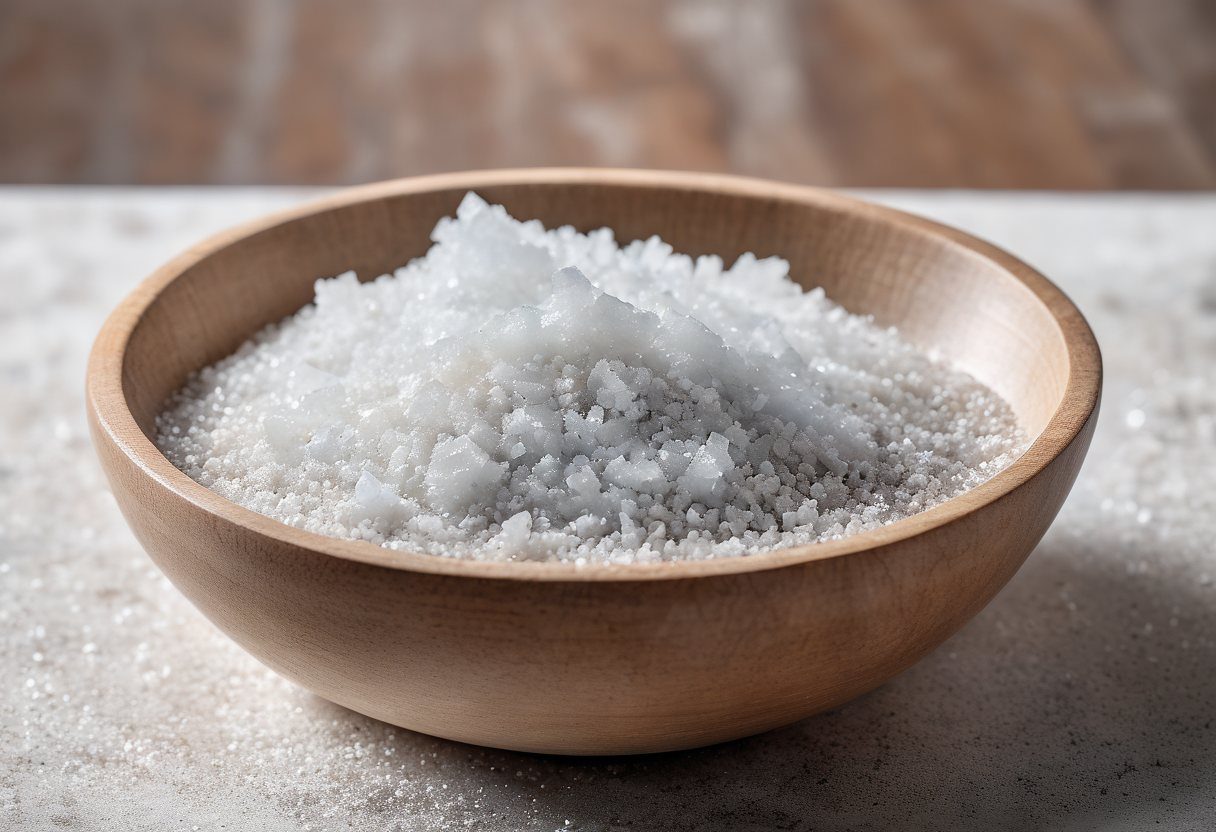
Celtic salt, a moist grey sea salt harvested from coastal ponds in Brittany, has become a wellness favorite, often stirred into water for “hydration” or recommended for its minerals. The label numbers answer both the sodium question and the mineral question.
How much sodium is in Celtic salt?
We pulled the Nutrition Facts data for Celtic Sea Salt products and other grey sea salts from the USDA’s FoodData Central branded food database and compared them with USDA’s entry for table salt:
| Salt | Sodium per 100 g | Per 1/4 teaspoon (label serving) |
|---|---|---|
| Table salt (USDA) | 38,800 mg | about 580 mg (1.5 g) |
| Celtic Sea Salt, light grey | 32,000 mg | 480 mg (1.5 g) |
| Celtic Sea Salt, fine ground | 35,200 mg | 458 mg (1.3 g) |
| Celtic Sea Salt, Flower of the Ocean | 33,300 mg | 500 mg (1.5 g) |
| Other French grey sea salts (5 brands) | 35,100 to 40,000 mg | 351 to 400 mg (1.0 g) |
Light grey Celtic salt is about 17% lower in sodium per gram than table salt. Moist sea salts carry some water, and their other minerals make up part of the weight, so a gram of them is slightly less than a gram of sodium chloride. Other grey sea salts in the database were much closer to table salt, at 35,100 to 40,000 mg per 100 g.
Per spoonful the numbers also depend on crystal size: coarse, damp crystals pack less densely than fine table salt. If you salt to taste, you may simply use more of a coarser salt, which erases the difference.
So how much can you have?
The Dietary Guidelines advise adults to keep sodium under 2,300 mg a day. At 480 mg per quarter teaspoon, that whole allowance equals about 1 1/4 teaspoons of light grey Celtic salt, and that is for everything you eat, not just what comes out of the salt jar. Bread, cheese, cured meats, soups, sauces and restaurant meals already carry sodium, and most Americans go over the limit before adding any. Our guide to how much sodium per day has the national intake figures.
The practical answer: use Celtic salt the way you would use any salt, to season food, and do not add extra because it is “natural.” Switching from table salt to Celtic salt at the same volume trims your sodium a little. Adding Celtic salt to water on top of your normal diet adds sodium.
Do the minerals make a difference?
Celtic salt does contain small amounts of other minerals. The question is whether the amounts matter.
- Magnesium: the only Celtic Sea Salt brand product in the database whose label lists magnesium, Makai Pure Deep, has 593 mg per 100 g. A quarter teaspoon (1.35 g) gives about 8 mg, roughly 2% of a man’s 420 mg RDA. Getting the full 420 mg from it would take about 71 g of salt, which by our calculation would carry about 20,500 mg of sodium, nearly nine times the daily limit. (See how much magnesium a man needs for food sources that work.)
- Iron: light grey Celtic salt lists 24 mg per 100 g, about 0.36 mg per quarter teaspoon, or 2% of the 18 mg Daily Value.
- Calcium: the Makai Pure Deep label lists 1,480 mg per 100 g, about 20 mg per quarter teaspoon, 2% of the Daily Value.
Researchers reached the same conclusion for pink salt. Fayet-Moore and colleagues analyzed 31 pink salts sold in Australia in 2020 and found that more than 30 g a day, about six teaspoons, would be needed to make any meaningful contribution to nutrient intake, a level that would provide excessive sodium. One sample also exceeded Australia’s maximum level for lead. Unrefined salts carry whatever else was in the sea or rock they came from.
The iodine gap
Celtic salt is not iodized. In the NIH Office of Dietary Supplements’ food table, a quarter teaspoon of iodized table salt provides 78 mcg of iodine, 52% of the Daily Value, while a quarter teaspoon of non-iodized sea salt provides 0. The ODS notes that iodized salt is the most widely used strategy to control iodine deficiency, and that many pregnant women in the United States may not get enough iodine. If Celtic salt replaces iodized salt in your kitchen, make sure iodine comes from elsewhere, such as dairy, eggs, seafood or, in pregnancy, a prenatal vitamin with iodine.
Celtic salt in water
Adding a pinch of Celtic salt to water is popular online as a hydration trick. We found no clinical trial comparing Celtic salt with ordinary salt for hydration, energy or any other health outcome. Athletes who sweat heavily for long periods may need to replace sodium, but for that purpose any salt works the same. For most people, a pinch in water is simply more sodium.
We do not link to any product on this page. The cheapest salt that seasons your food well, used sparingly, is as good as any.
Frequently Asked Questions
How much Celtic salt per day is safe?
Keep total sodium from all foods under 2,300 mg a day. Light grey Celtic salt has about 480 mg of sodium per quarter teaspoon, so the entire daily limit is roughly 1 1/4 teaspoons, and most people already reach it from food.
Is Celtic salt healthier than table salt?
Only slightly, and only by weight. Light grey Celtic salt has about 17% less sodium per gram than table salt, but it is still mostly sodium chloride, its trace minerals are too small to matter, and it lacks the iodine in iodized salt.
Does Celtic salt have magnesium?
A little. The Celtic Sea Salt brand label that lists magnesium shows about 8 mg per quarter teaspoon, around 2% of a man’s daily requirement. Meeting magnesium needs from salt would mean eating a harmful amount of sodium.
Should I put Celtic salt in my water?
There is no evidence it hydrates better than plain water or any other salt. Unless you sweat heavily for long periods, it mainly adds sodium to your day.
Is Celtic salt iodized?
No. A quarter teaspoon of iodized table salt has about 78 mcg of iodine; non-iodized sea salt has none. If you switch, get iodine from other foods.
The Bottom Line
Celtic salt is salt. It is modestly lower in sodium per gram than table salt, but the daily limit is the same, and that limit is about 1 1/4 teaspoons of Celtic salt from all food combined. Its minerals are too small to count, and it has no iodine. Use it for flavor, not for health.
Sources
- USDA Agricultural Research Service. FoodData Central, Branded Foods, searches for “celtic sea salt”, “celtic salt” and “grey sea salt”, queried 27 September 2026. Celtic Ocean International labels: light grey Celtic Sea Salt 32,000 mg sodium and 24 mg iron per 100 g (serving 1.5 g, 1/4 tsp); fine ground 35,200 mg sodium per 100 g (1.3 g); Flower of the Ocean 33,300 mg (1.5 g); Makai Pure Deep 28,900 mg sodium, 593 mg magnesium, 1,480 mg calcium per 100 g (1.35 g). French grey sea salts (Compagnie des Salins du Midi, LJW, Walmart, Roland, Esprit du Sel): 35,100-40,000 mg sodium per 100 g (1.0 g). Table salt (SR Legacy 173468): 38,800 mg sodium per 100 g. Per-serving figures and the magnesium calculation are ours. fdc.nal.usda.gov.
- Fayet-Moore F, Wibisono C, Carr P, et al. An analysis of the mineral composition of pink salt available in Australia. Foods, 2020;9(10). PMID 33086585. 31 pink salts; more than 30 g per day (about 6 teaspoons) needed for a meaningful nutrient contribution; one sample exceeded the national maximum level for lead. Checked 27 September 2026.
- NIH Office of Dietary Supplements. Iodine: Fact Sheet for Health Professionals (updated 5 November 2024): iodized table salt 1/4 tsp 78 mcg (52% DV); non-iodized sea salt 1/4 tsp 0 mcg; US iodized salt contains 45 mcg iodine per gram and iodization is voluntary; iodized salt is the most widely used strategy against iodine deficiency; many US pregnant women may consume insufficient iodine. ods.od.nih.gov. Checked 27 September 2026.
- US Department of Agriculture and US Department of Health and Human Services. Dietary Guidelines for Americans: adults should limit sodium to less than 2,300 mg per day. dietaryguidelines.gov. Checked 27 September 2026.
- NIH Office of Dietary Supplements. Magnesium and Iron fact sheets: magnesium RDA 420 mg for men 31 and older; Daily Values 18 mg iron and 1,300 mg calcium. ods.od.nih.gov. Checked 27 September 2026.
- Europe PMC literature search for “celtic salt” and “celtic sea salt”, 27 September 2026: no clinical trial comparing Celtic salt with ordinary salt for a health outcome. europepmc.org.