Red Light Therapy at Home: 3 Numbers Your Panel Has to Tell You
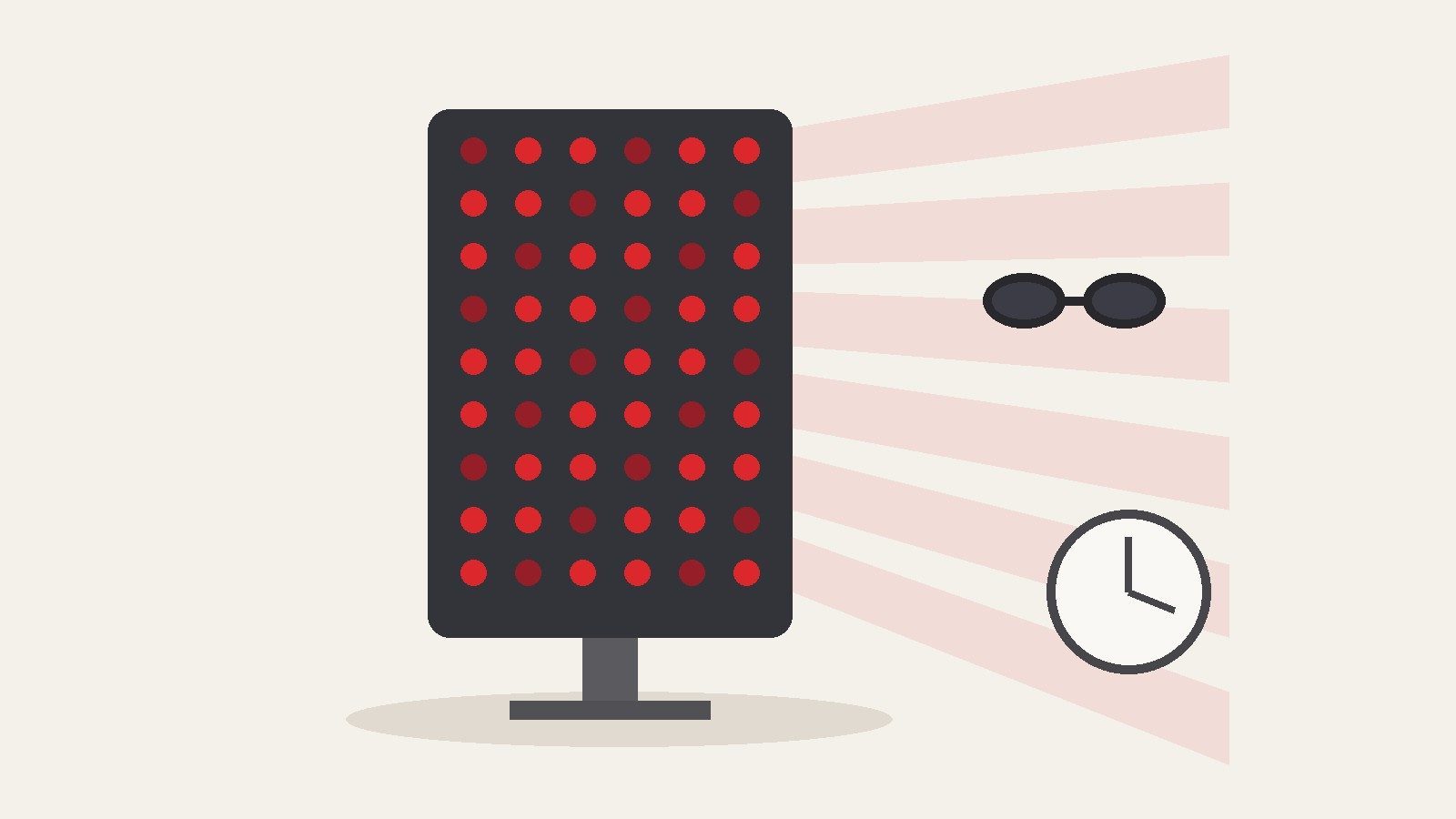
Quick Answer: A red light panel can only be compared with the research if it tells you three numbers: the wavelength (nm), the irradiance at a stated distance (mW/cm²), and how long a session lasts. Multiply irradiance by time and you get the dose the trials report, in joules per square centimetre (J/cm²). The skin trial we cite used about 9 J/cm² of 611–650 nm light, twice a week, for 30 sessions. The hair trial used a 655 nm helmet at home every other day for 16 weeks. At a panel’s advertised 134 mW/cm², 9 J/cm² takes roughly 67 seconds by our arithmetic, so “more minutes” is not the same as “closer to the trials”. No trial we read compared one frequency with another, so the honest answer to “how often” is: as often as the protocol you are copying. Most home panels have no FDA 510(k) clearance under their own name. An advertised panel is in the box near the end of this page.
Our red light therapy benefits page sorts which claims have strong trials behind them. This page is about the step after that: you have decided to try a panel at home, and you want to use it the way the studies did. That means reading a spec sheet the way a researcher would.
The 3 numbers, and why each one matters
1. Wavelength (nm)
Wavelength is the colour of the light. Red is roughly 600–700 nm; near-infrared, which you cannot see, is above about 700 nm. The trials below used specific bands: 655 nm for hair, 611–650 nm for skin, and 785–860 nm or 904 nm lasers for knee pain. A panel that lists 630, 660, 810 and 850 nm covers red and near-infrared, but a listed wavelength does not tell you how much of the output sits at each one.
One detail from the skin trial is useful here. Wunsch and Matuschka compared a red-only source (611–650 nm) with a broad 570–850 nm source and concluded that “broadband polychromatic PBM showed no advantage over the red-light-only spectrum.” More wavelengths on the box is not, on that evidence, an advantage in itself.
2. Irradiance (mW/cm²) at a stated distance
Irradiance is how much light power lands on each square centimetre of skin. It falls as you move away from the panel, which is why a figure is only meaningful with a distance attached. Manufacturers usually quote it “at 6 inches”. If you sit further away, you receive less, and the seconds you need go up.
These figures are the seller’s own measurements. Nobody independent checks them before sale. The advertised panel in the box below is a good example of why to read carefully: its product page lists “134 mW/cm² @ 6 in” in its comparison table and, in a bullet list on the same page, “Over 157mW/cm² irradiance at 6 inches”. In that same table, 157 mW/cm² is the figure for the larger 156-LED model.
3. Time per session
Time turns irradiance into dose. Without it, two panels with the same wavelength can deliver very different amounts of light.
Turning a panel’s numbers into a trial dose
The formula is simple: fluence (J/cm²) = irradiance (W/cm²) × time (seconds). 1 mW is 0.001 W. The figures in this section are our arithmetic from published numbers, not values the studies or the manufacturer give.
| Target dose | From | At 134 mW/cm² | At 50 mW/cm² (further away) |
|---|---|---|---|
| 9 J/cm² | Skin trial (Wunsch 2014) | about 67 seconds | about 3 minutes |
| 67.3 J/cm² per 25 minutes | Hair trial (Lanzafame 2013) | about 8.4 minutes | about 22 minutes |
Two cautions. First, the hair trial’s abstract states “67.3 J/cm(2) irradiance/25 minute treatment”; dividing that by 25 minutes gives an average of about 45 mW/cm², again our arithmetic. Its device was a helmet sitting on the scalp, not a panel at a distance. Second, the knee pain review reports dose in joules per treatment spot (“4-8 J with 785-860 nm wavelength and at 1-3 J with 904 nm wavelength per treatment spot”), for lasers applied to points on the joint. That unit cannot be converted into a panel session without knowing the spot size, so we do not try.
What the trials actually used
| Use | Study | Light | Dose | Schedule | Result |
|---|---|---|---|---|---|
| Male pattern hair loss | Lanzafame 2013, 44 men, double-blind | Helmet with 21 lasers (5 mW) and 30 LEDs, 655 nm | 67.3 J/cm² per 25-minute treatment, as stated | At home, every other day for 16 weeks (60 treatments) | 39% increase in hair counts vs placebo |
| Skin texture and wrinkles | Wunsch 2014, 136 volunteers, controlled | 611–650 nm or 570–850 nm polychromatic light | About 9 J/cm² in the 611–650 nm range | Twice a week, 30 sessions | Improved complexion, roughness and collagen density vs controls |
| Knee osteoarthritis pain | Stausholm 2019, 22 trials, 1,063 people | Lasers, 785–860 nm or 904 nm | 4–8 J or 1–3 J per treatment spot | Varied by trial (not given in the abstract) | Pain 18.71 mm lower on a 100 mm scale at recommended doses |
Notice what is missing from this table: a trial of a free-standing home LED panel. The hair study used a cap-like device on the head; the knee trials used lasers on specific points; the skin study used purpose-built light sources. A panel can deliver the same wavelength, but it is not the device that was tested.
How often should you do red light therapy?
The trial protocols are the only evidence-based answer we found, and they differ by use:
- Hair: every other day, for 16 weeks (Lanzafame 2013).
- Skin: twice a week, 30 sessions in total (Wunsch 2014).
- Knee pain: the review does not give a single schedule in its abstract. It did report that pain relief at recommended doses “peaked during follow-ups 2-4 weeks after the end of therapy”, so benefit was still building after sessions stopped.
None of the trials we cite compared one frequency with another. That means “every day is better than twice a week” is not something these studies tested. If you want your sessions to resemble the research, copy one protocol, including its schedule and its length, and give it the full duration before judging it.
Can you do red light therapy every day?
The hair trial used every other day and the skin trial twice weekly; neither tested daily use. We found no evidence in these trials that daily sessions add benefit. Follow the device’s own instructions on maximum use.
How long should each session be?
Long enough to reach the dose of the protocol you are copying, at the distance you actually sit. Use the formula above with the irradiance your manual gives for that distance. At high-output panel figures, the skin trial’s 9 J/cm² is a matter of about a minute, by our arithmetic.
Are home red light panels FDA approved?
The word is usually wrong. FDA does not “approve” these devices; it clears some of them through the 510(k) process for a specific use. On 18 October 2026 the openFDA 510(k) database held 163 records under the code for over-the-counter wrinkle-reduction light devices (OHS), 114 under hair-growth lasers (OAP) and 54 under adjunctive pain-therapy lasers (NHN). Each clearance is for that indication, not for “red light therapy” in general.
A search of the same database for the names FliKEZE and SpectraPanel returned no records. A device can be cleared under its factory’s name rather than the brand on the box, so the reliable check is to ask the seller for the device’s 510(k) number (it starts with K) and look it up on FDA’s database yourself. A product page that says “Verified by FDA” without a K-number is not something you can verify.
Eye safety
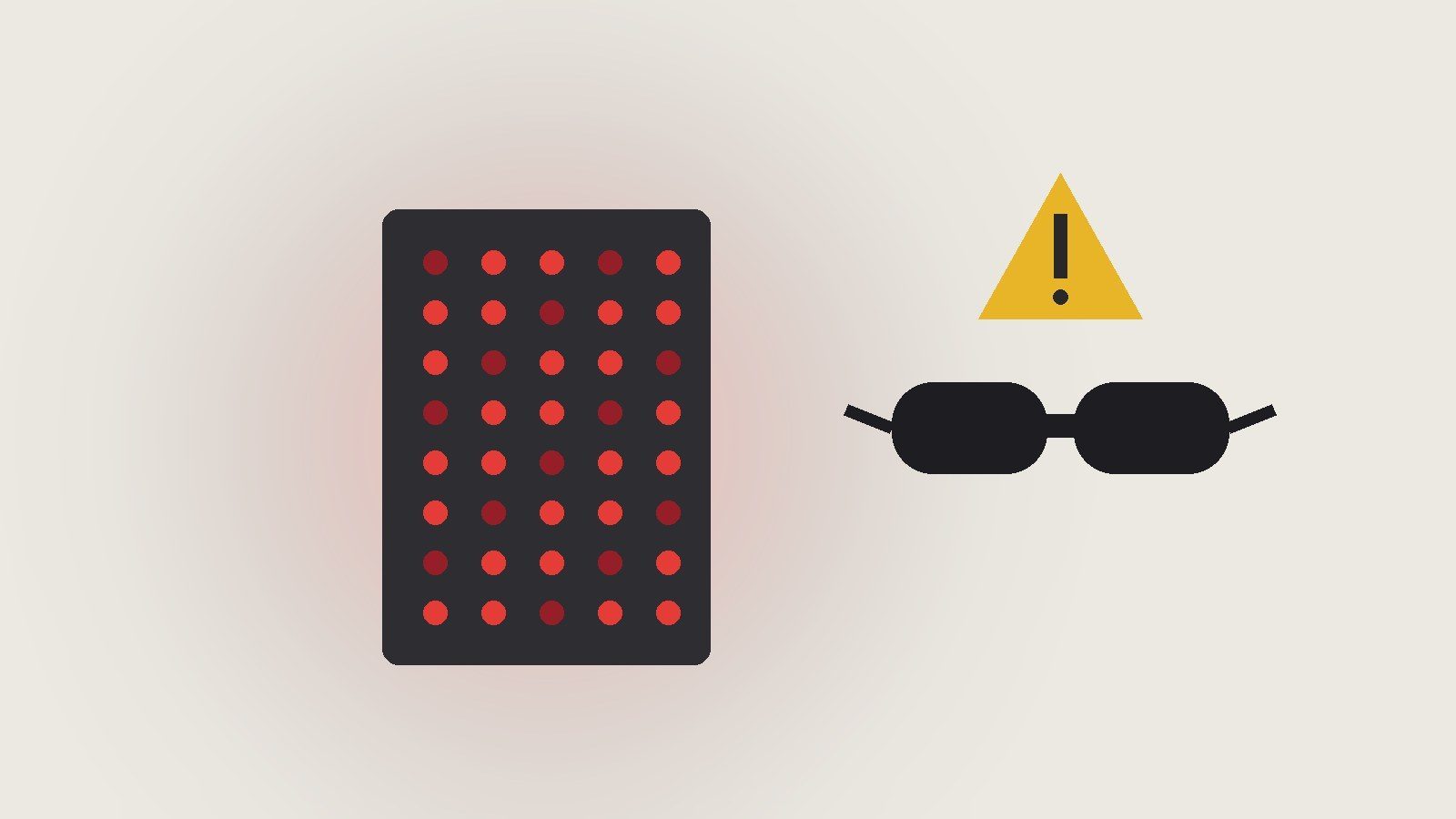
Home panels are meant to shine on skin, not into your eyes, and most ship with protective goggles. The strongest safety warnings we found come from a different kind of device: red light lasers aimed into the eye to slow myopia in children. A 2023 case report in JAMA Ophthalmology described retinal damage in a 12-year-old after repeated low-level red-light laser exposure. A 2026 laboratory study of four such myopia devices found that two laser-based units reached ANSI safety limits within 2.8 and 1.4 seconds for a 7 mm pupil, while an LED-based device took 22,761 seconds. Its authors concluded that laser-based instruments “deliver irradiance levels that reach ANSI safety limits within exposure times below the recommended 180-second treatment time.”
Those findings are about eye-directed devices, not body panels. They are still a reason to wear the supplied eye protection, to avoid looking into the LEDs, and to keep panels away from children’s eye level.
Panels vs masks vs caps
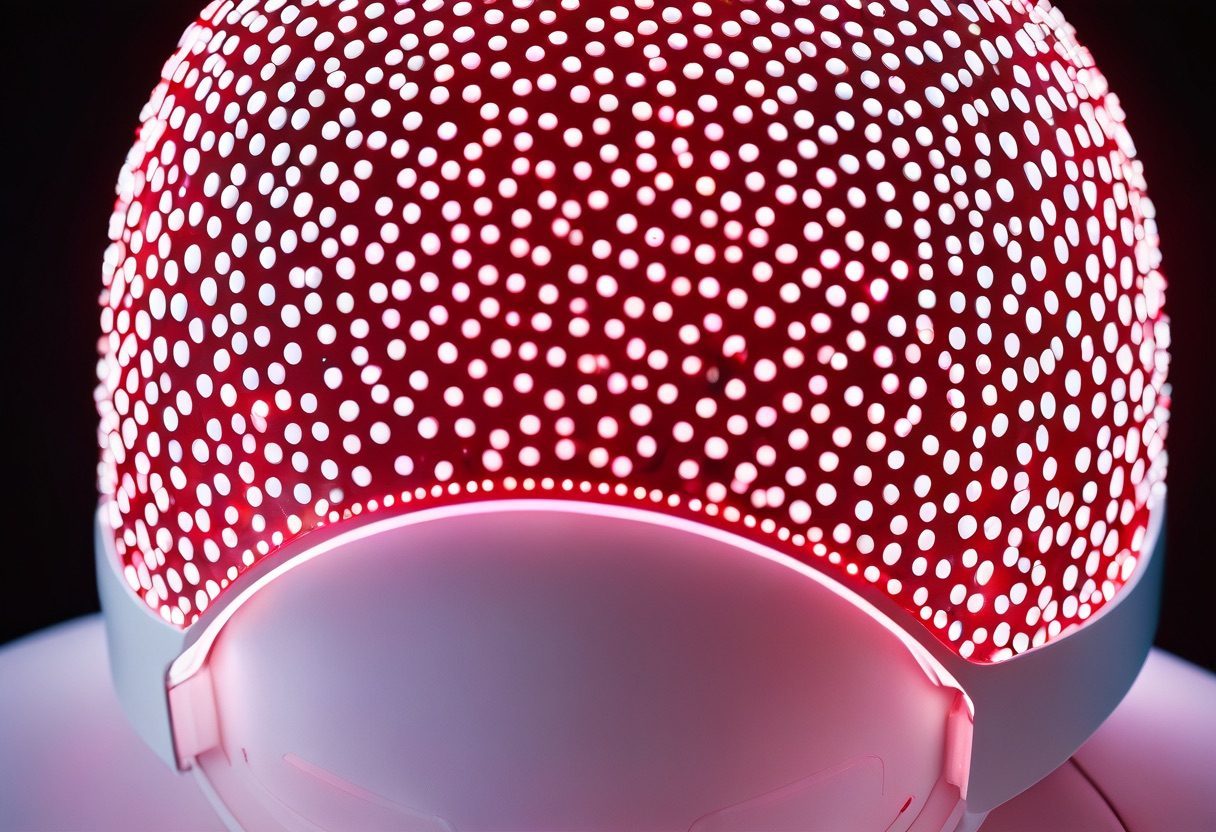
The device should match the trial you are copying. The hair evidence comes from a cap-like device worn on the scalp; a wall panel lights the whole face and body at a distance, and its output at the scalp depends on how close you sit. For facial skin, LED masks are a separate category with their own clearances (many of the 163 OHS records are masks); we cover them separately.
Frequently Asked Questions
How often should you do red light therapy at home?
Copy the protocol for your goal. The hair trial used every other day for 16 weeks; the skin trial used twice a week for 30 sessions. No trial we read compared frequencies, so there is no evidence that more frequent sessions work better.
How long should a red light panel session be?
Calculate it: dose (J/cm²) divided by irradiance (W/cm²) at your distance gives seconds. At 134 mW/cm², the skin trial’s 9 J/cm² takes about 67 seconds by our arithmetic.
What wavelength should a red light panel have?
The trials we cite used 655 nm for hair, 611–650 nm for skin, and 785–860 nm or 904 nm lasers for knee pain. The skin trial found that a broad 570–850 nm spectrum had no advantage over red alone.
Are red light therapy panels FDA approved?
FDA clears, rather than approves, some light-therapy devices for specific uses through 510(k). Many panels have no clearance under their brand name; ask the seller for the K-number and check it on FDA’s database.
Is red light therapy safe for your eyes?
Reports of retinal damage involve red light lasers aimed into the eye for myopia, not body panels. Wear the eye protection supplied and do not look into the LEDs.
Does red light therapy work through clothes?
The trials we cite applied light directly to skin or to a scalp with hair trimmed to 3 mm. We found no trial testing light through clothing, so treat bare skin if you want to match the research.
The Bottom Line
A home red light panel is a light source; whether it matches the research depends on three numbers you can check: wavelength, irradiance at your distance, and session time. Turn them into a dose, pick one trial protocol, and follow its schedule for its full length. Ask for a K-number before you believe an “FDA” claim, and protect your eyes.
Advertisement
FliKEZE SpectraPanel Pro 78. A red and near-infrared LED panel. Its product page lists 630, 660, 810 and 850 nm, and gives its irradiance as “134 mW/cm² @ 6 in” in one place and “Over 157mW/cm² irradiance at 6 inches” in another. This is a paid placement, not a recommendation, and none of the trials above used this device. The page says “Verified by FDA”; we found no 510(k) record under the FliKEZE or SpectraPanel names (openFDA, 18 October 2026), so ask the seller for the K-number before relying on that claim.
Sponsored link — we may earn a commission at no extra cost to you. If you have a light-sensitive condition or take medicines that cause light sensitivity, ask your doctor before using a light therapy device.
Sources
- Lanzafame RJ, et al. The growth of human scalp hair mediated by visible red light laser and LED sources in males. Lasers Surg Med. 2013;45(8):487-95. 44 men; “TOPHAT655” unit with 21, 5 mW lasers and 30 LEDs at 655 nm; “treated at home every other day × 16 weeks (60 treatments, 67.3 J/cm(2) irradiance/25 minute treatment)”; 39% increase in hair counts; hairs trimmed to 3 mm. PMID 24078483. Checked 18 October 2026.
- Wunsch A, Matuschka K. A controlled trial to determine the efficacy of red and near-infrared light treatment in patient satisfaction, reduction of fine lines, wrinkles, skin roughness, and intradermal collagen density increase. Photomed Laser Surg. 2014;32(2):93-100. 136 volunteers; “treated twice a week with either 611-650 or 570-850 nm polychromatic light (normalized to ∼ 9 J/cm(2) in the range of 611-650 nm)”; 30 sessions; “Broadband polychromatic PBM showed no advantage over the red-light-only spectrum.” PMID 24286286. Checked 18 October 2026.
- Stausholm MB, et al. Efficacy of low-level laser therapy on pain and disability in knee osteoarthritis: systematic review and meta-analysis. BMJ Open. 2019;9(10):e031142. 22 trials, n=1063; 18.71 mm at recommended doses; “peaked during follow-ups 2-4 weeks after the end of therapy”; “4-8 J with 785-860 nm wavelength and at 1-3 J with 904 nm wavelength per treatment spot”; LLLT “is not recommended in major knee osteoarthritis (KOA) treatment guidelines”. PMID 31662383. Checked 18 October 2026.
- Liu H, et al. Retinal Damage After Repeated Low-level Red-Light Laser Exposure. JAMA Ophthalmol. 2023;141(7):693-695. Case report, 12-year-old female with myopia. PMID 37227712. Checked 18 October 2026.
- Ostrin LA, Schill AW. Safety Evaluation of 4 Red Light Therapy Devices for Myopia. JAMA Ophthalmol. 2026;144(3):255-258. Two laser devices reached ANSI group 1 limits within 2.8 and 1.4 seconds for a 7 mm pupil; LED-based device 22,761 seconds. PMID 41642586. Checked 18 October 2026.
- U.S. Food and Drug Administration. openFDA device 510(k) API. Records by product code on 18 October 2026: OHS 163, OAP 114, NHN 54; searches for “FliKEZE” and “SpectraPanel” returned no records. open.fda.gov. Checked 18 October 2026.
- FliKEZE SpectraPanel Pro 78 product page: wavelengths 630, 660, 810, 850 nm; “134 mW/cm² @ 6 in”; “Over 157mW/cm² irradiance at 6 inches”; “Verified by FDA”. flikeze.com. Checked 18 October 2026.